
Table of Contents
Background and Context: Growth of Islamic Banking
Six decades later, the industry that grew out of experiments like these holds assets measured in trillions of dollars, operates in dozens of countries and has attracted attention from regulators, investors and ordinary savers well beyond Muslim communities. This article tells that growth story with numbers, explains what is driving it and where it is happening, and gives equal time to the problems that growth has not solved. Because many of our readers live in Pakistan, one of the key markets in South Asia, we also look at where the country stands.
Key Takeaways
- Modern Islamic banking began with small experiments in the 1960s and became a commercial industry in the mid-1970s.
- Industry bodies estimate global Islamic finance assets between roughly 4 and 6 trillion dollars, depending on how the industry is counted, with growth running well above that of many conventional markets.
- The market is concentrated: a handful of countries, led by Iran, Saudi Arabia and Malaysia, hold most of the assets.
- Growth is driven by demand from Muslim customers, supportive laws, sovereign sukuk, interest in ethical investing and new financial technology.
- Real challenges remain, including inconsistent rulings between scholars, a shortage of skilled staff, limited liquidity tools and the question of whether some products differ enough from conventional ones.
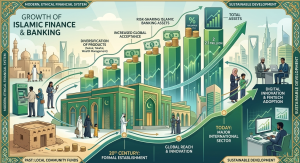
Islamic banking has grown from small local experiments into a global industry.
A Short History
The experiments of the 1960s
The first modern attempts were modest. The Mit Ghamr savings project in Egypt, begun in 1963, combined rural savings with profit-sharing investments. In the same year, Malaysia set up its pilgrims’ savings fund. Both showed that people would use finance built on different principles, but neither was a full commercial bank.
The 1970s: oil money and the first banks
The major turning point came in the mid-1970s. Oil prices jumped after 1973, Gulf states accumulated large surpluses, and demand rose for places to invest them in line with religious beliefs. The Islamic Development Bank began operating in 1975, and so did Dubai Islamic Bank, widely described as the first Islamic commercial bank. Other institutions in Kuwait, Sudan, Egypt and Bahrain followed in the late 1970s. We explore how oil revenue shapes economies in our piece on global oil shocks and geopolitical conflicts.
The 1980s and 1990s: governments step in
Some countries went further than letting a few banks open. Iran, Sudan and Pakistan took steps in the 1980s to reshape their banking systems around interest-free principles, with very different results. Malaysia chose a different path, passing its Islamic Banking Act in 1983 and building a system in which Islamic and conventional banks operate side by side. Bahrain became a base for standard-setting, and the accounting body AAOIFI was established there in the early 1990s.
The 2000s: sukuk and mainstream attention
The 2000s brought the sukuk market into the spotlight. Governments and large companies began raising billions through Islamic bonds. The Islamic Financial Services Board was set up in 2002 to issue prudential standards. In Pakistan, Meezan Bank opened in 2002 as the country’s first full-fledged Islamic bank. After the global financial crisis of 2008, many observers took a fresh look at finance linked to real assets, though, as we discuss below, the claim that Islamic banks were simply safer needs careful treatment.
The 2010s and 2020s: going global and digital
Outside the Muslim world, the United Kingdom issued the first sovereign sukuk by a Western government in 2014, and other financial centres, from Luxembourg to Hong Kong, built frameworks to host Islamic products. More recently, digital banks, fintech apps and green sukuk have become the new frontier.
How Big Is It?
Here the picture is less tidy than headlines suggest, because different organisations count the industry differently. Two respected sources illustrate the point:
| Source | Figure | Notes |
|---|---|---|
| LSEG and the Islamic Corporation for the Development of the Private Sector (2025 report) | About 5.98 trillion US dollars in 2024, up 21 percent on the year | Projected to reach about 9.7 trillion by 2029, growing around 10 percent a year. Covers 140 countries and counts Iran’s large system |
| Islamic Financial Services Board (stability reports) | About 3.88 trillion dollars at the end of 2024, up about 15 percent, and about 4.4 trillion in 2025 | Counts the industry using supervisory data from member jurisdictions |
Why the gap? Definitions, country coverage and the treatment of Iran’s banking system differ between the two. The sensible reading is that the industry is clearly in the multi-trillion-dollar range and growing fast, while the exact total depends on who is counting. When you see a single number in a headline, ask whose it is.
A few other facts from these reports help frame the scale. Islamic banking now operates in about 84 markets. The outstanding sukuk market passed one trillion dollars in 2024 and continued to grow. And the market is heavily concentrated: Iran, Saudi Arabia and Malaysia together account for roughly 72 percent of the total, and the Gulf and East Asia-Pacific regions hold around three-quarters of all assets, according to the 2026 stability report.
Projections deserve a caution. A forecast of 9.7 trillion dollars by 2029 is an extrapolation of current trends, not a promise. Interest rates, oil prices, regional conflicts and regulatory choices can all change the path.
What Is Driving Growth
Demand from a growing customer base
Nearly two billion people identify as Muslim, and many want financial products that match their beliefs. In countries where Islamic and conventional options sit side by side, a significant number of customers choose the Islamic option purely out of conviction, which gives the industry a loyal base that grows with the population.
Supportive laws and regulators
Industry growth follows regulation. Countries such as Malaysia, the UAE, Saudi Arabia, Bahrain and Pakistan wrote specific laws, created Shariah governance rules and trained supervisors. Clear rules make it easier for banks to launch products and for customers to trust them.
Governments as big borrowers
Sovereign sukuk give governments a way to raise money that suits Islamic banks and investors, who otherwise had few safe places to park surplus funds. When a government issues sukuk regularly, it creates a benchmark for pricing and a pool of high-quality assets for the whole industry. For a closer look, read our guide to Islamic sukuk.
Interest in ethical and sustainable investing
The rise of environmental, social and governance investing has overlapped with Islamic finance’s focus on screening out harmful sectors and linking money to real assets. Some non-Muslim investors have bought Islamic products for this reason, and green sukuk sit squarely where the two ideas meet.
Attention after financial crises
After 2008, debates about excessive leverage and complex derivatives made many people curious about finance built on asset backing and risk sharing. Curiosity does not equal proof of superiority, but it did open doors and bring new customers and researchers to the field.
Technology
Mobile banking, digital onboarding and online investment platforms have lowered the cost of reaching new customers, which helps smaller Islamic banks compete with bigger conventional rivals.
How Do Islamic Banks Make Money? Understanding Sharia-Compliant Profit Models
Islamic banks generate income through financial activities structured around Sharia principles, which prohibit riba (interest) and emphasise trade, asset ownership, leasing, and permissible investment. Instead of relying solely on conventional interest-based lending, these institutions use different contractual arrangements to finance businesses, support consumers, and facilitate commercial transactions. Their earnings depend on the type of agreement, the assets involved, and the financial risks associated with each transaction.
One common method is Murabaha, in which a bank purchases an asset requested by a customer and resells it at an agreed price that includes a disclosed profit margin. Under Ijara, the institution earns rental income by leasing an asset to a customer according to the contract. Islamic banks may also participate in business ventures through Musharakah, a partnership in which parties contribute capital and share profits according to agreed terms, while losses are generally allocated according to their capital contributions. In Mudarabah, one party provides capital and another manages the business, with profits distributed according to an agreed ratio and financial losses generally borne by the capital provider, unless negligence or contractual misconduct is established.
The Role of Trade, Investment, and Financial Services
Islamic banks can also earn revenue from Sharia-compliant investments, asset-based financing, and permissible banking services. Their operations must follow applicable Sharia governance requirements, regulatory standards, and contractual obligations. The precise structure of these products varies between institutions and jurisdictions.
Understanding these income sources helps explain how Islamic banking differs from conventional financial models. However, Sharia-compliant financing does not mean that every transaction is automatically risk-free or that customers always receive lower costs. Profit margins, rental payments, business performance, fees, and contractual conditions all influence the financial outcome. Examining these mechanisms provides a clearer picture of how Islamic banks seek to remain commercially sustainable while operating within their religious and regulatory framework.
The Products Behind the Numbers
Most of the industry’s growth rests on a small set of contracts. The big ones are murabaha (cost-plus sale), ijara (leasing), musharaka and mudaraba (partnerships), sukuk (asset-backed certificates) and takaful (mutual insurance). Our companion article on Islamic economics and its principles explains how each one works, so we will not repeat the mechanics here.
What matters for the growth story is the mix. In practice, sale-based and lease-based contracts dominate retail and corporate banking, because they are easier to price and manage than true profit-and-loss sharing. Partnership contracts, the ones most often held up as the heart of Islamic finance, make up a much smaller part of actual business. That gap between the ideal and the everyday practice is among the most debated points in the field, and we return to it in the challenges section.
Where the Growth Is Happening
| Region or country | What stands out |
|---|---|
| Gulf Cooperation Council (Saudi Arabia, UAE, Qatar, Kuwait, Bahrain) | Large, well-capitalised Islamic banks, heavy sukuk issuance and strong government backing. Saudi Arabia is one of the three biggest markets |
| Malaysia | A dual system with a deep Islamic capital market and a leading position in sukuk. Often ranked at or near the top for overall development |
| Iran | Operates a banking system that is intended to be interest-free, which makes it one of the largest by assets in industry statistics |
| South Asia (Pakistan, Bangladesh) | Fast-growing retail Islamic banking. Bangladesh, long viewed as a strong market, slipped out of the top ten of one 2025 development ranking, according to summaries of the report, owing to challenges in its Islamic banking sector |
| Turkey and Central Asia | Participation banks (Turkey’s term for Islamic banks) are growing with government encouragement |
| Africa | Sudan, Egypt and Nigeria have established players, while newer entrants such as Tanzania are showing promise through sukuk and sector growth |
| United Kingdom, Luxembourg, Hong Kong | Hubs that host sukuk issuance and Islamic funds, and attract international investors |
Two lessons come out of this map. First, growth is uneven, and the concentration means that developments in a few countries move the global totals. Second, the industry is expanding into places with small Muslim populations, mainly through capital markets and funds, which supports the claim that its appeal reaches beyond faith.
Pakistan’s Story
Pakistan has one of the most closely watched Islamic banking experiences, with several turns along the way. Early attempts at converting the whole system in the 1980s ran into legal and practical problems and were shelved. A new approach began in the early 2000s, when the State Bank of Pakistan laid out a framework for a dual system in which Islamic and conventional banks operate in parallel. Meezan Bank opened in 2002, and Islamic branches and windows of conventional banks spread across the country.
The results have been strong in terms of reach. According to State Bank data published in recent years, Islamic banking has risen to about a fifth of the banking sector’s assets and deposits, and the number of branches has grown into the thousands. The exact current share is published in the State Bank’s Islamic banking bulletins, so check there before quoting a precise figure.
The government has also used Islamic instruments for its own borrowing. Ijara sukuk backed by state assets have been auctioned regularly, giving Islamic banks a place to invest and the Treasury another source of funding. Our article on monetary policy shows how interest-based benchmarks still shape borrowing costs across the economy, and that is one reason why the transition is complex.
Legal developments add urgency. In April 2022, the Federal Shariat Court ruled that the interest-based system conflicts with Islamic injunctions and set a deadline at the end of 2027 for moving away from it. The ruling has been challenged, and the matter is still moving through the legal and policy process, so please verify its current status. Whatever the outcome, the practical questions are the same: does the country have enough Shariah-compliant instruments, trained people and clear rules to run a larger Islamic system safely?
Is It More Stable? What the Evidence Says
One of the most common claims about Islamic banking is that it is inherently safer, because it ties finance to real assets and bans speculation. The claim is partly true, but only partly.
What supports it. During the 2008 crisis, many Islamic banks were less exposed to the complex mortgage securities and derivatives that caused large losses at conventional banks. Their emphasis on asset-backed financing and their restrictions on certain speculative activities gave them some protection in the early phase of that shock.
What complicates it. Research since then has produced mixed findings. Some studies find Islamic banks better capitalised and more resilient in particular periods, while others find them no safer or even more vulnerable in certain conditions. They carry their own risks: heavy concentration in property and a few sectors, fewer tools for managing short-term liquidity, governance weaknesses where Shariah boards are not independent, and in some markets, high exposure to a single government. Sukuk have also had their disputes, such as the 2017 case involving a UAE energy company that challenged its own sukuk, which raised questions about how contracts are enforced.
The fair conclusion is that Islamic finance can reduce certain risks, but it is not a shield against bad management, weak regulation or economic shocks. Good supervision matters in both systems.
Technology and Green Finance
Digital Islamic banking
New digital banks and apps are targeting younger customers who expect smooth online services. Mobile onboarding, instant transfers and robo-style investment platforms built to screen for Shariah compliance are spreading, and several established Islamic banks are rebuilding their systems around digital channels. For smaller banks and for countries with few branches, digital delivery lowers the cost of reaching customers.
Green and sustainability sukuk
Issuers have started raising money through sukuk earmarked for solar plants, clean transport, water projects and similar uses. According to the 2026 stability report, sukuk issuance linked to sustainability and climate has grown strongly. The pairing makes sense: sukuk are tied to real projects by design, and sustainability labels add a layer of reporting about how the money is used. Our article on how global warming affects economies explains why this kind of funding is in demand.
Other frontiers
Islamic insurance, asset management and microfinance are growing faster than banking in some markets, according to industry reports. Takaful in particular has grown at double-digit rates in several emerging markets, helped in part by mandatory insurance requirements.
Challenges That Remain
- Different rulings in different places. A structure approved by scholars in one country may be rejected in another, which complicates cross-border business. AAOIFI and the IFSB publish standards to narrow the gaps, but full harmonisation is a long way off.
- Form versus substance. Critics argue that some products, especially fixed-markup sales, behave much like conventional loans. Defenders respond that the legal and risk structure is truly different, since the bank must own the asset and carry related risks. The debate is healthy and ongoing.
- Heavy concentration. With three countries holding most of the assets, the industry’s global story depends heavily on a few regulators and economies.
- Talent shortage. Banks need professionals who understand both Islamic jurisprudence and modern finance, and there are not enough of them.
- Competition and scale. Conventional banks are bigger, offer more services and often have lower costs, which makes it hard for Islamic competitors to win customers on price alone.
- Liquidity tools. The set of Shariah-compliant instruments for managing short-term cash is still thinner than in conventional markets.
- Governance and trust. Customers rely on Shariah boards and disclosure. If a bank’s practices fall short of its claims, trust can be damaged for the whole industry.
- Awareness. Many customers do not clearly understand how products differ, which opens the door to confusion and sometimes to misleading marketing.
- Uneven data. As we saw, size estimates differ widely by source, and comparing countries or years requires care.
The Outlook
Several trends point toward further growth. Muslim populations are young and growing, governments in several countries are keen to expand Islamic finance, digital channels are cutting costs, and demand for sustainable investment continues. Industry projections foresee growth of roughly ten percent a year in assets over the next several years.
At the same time, the future is not guaranteed. A sharp fall in oil prices could dry up Gulf liquidity, higher interest rates change how sukuk and conventional bonds compete for investors, and regulatory reversals or governance scandals could damage trust. The most reasonable expectation is continued expansion with plenty of bumps, and with the biggest gains going to markets that combine clear rules, honest supervision and customers who understand what they are buying.
For readers who want a practical checklist, here are a few habits that serve anyone looking at an Islamic bank or fund:
- Ask which contract is used and read its terms in writing.
- Check that the institution is licensed and that its Shariah board is named.
- Compare the total cost with conventional alternatives, since price matters in both systems.
- Be careful with schemes that use religious language but are not regulated.
- For religious questions, consult qualified scholars, not marketing material.
Frequently Asked Questions
When did Islamic banking begin?
Small experiments appeared in the early 1960s in Egypt and Malaysia, and the first Islamic commercial banks opened in the mid-1970s. The industry marked fifty years of commercial banking in 2025.
How big is the Islamic finance industry?
Estimates range from about 4 to 6 trillion dollars depending on the source and the method of counting. Industry reports describe annual growth well above that of many conventional markets.
Which countries have the largest Islamic finance markets?
Iran, Saudi Arabia and Malaysia are the three largest by assets, followed by the UAE, Qatar, Kuwait, Turkey and other countries, with Pakistan and Bangladesh as key South Asian markets.
Why is Islamic banking growing?
Because of demand from Muslim customers, supportive laws, government sukuk issuance, interest in ethical investing and the spread of digital channels.
Is Islamic banking safer than conventional banking?
It can reduce some risks, such as exposure to speculative products, but it faces its own risks. Studies show mixed results, and the quality of regulation and management matters in both systems.
What is the share of Islamic banking in Pakistan?
It has risen to roughly a fifth of banking assets and deposits in recent years. The State Bank of Pakistan publishes the latest figures in its Islamic banking bulletins.
Can non-Muslims use Islamic banks?
Yes. Islamic banks serve customers of all backgrounds, and many non-Muslim investors buy sukuk and Islamic funds.
What is the difference between a sukuk and a bond?
A conventional bond is a loan that pays interest. A sukuk represents a share in an asset or project and pays returns from that asset’s income. Our guide to Islamic sukuk goes into detail.
Final Thoughts
The growth of Islamic banking is a real and impressive story. A handful of small experiments in the 1960s turned into a global industry with trillions of dollars in assets, a thriving sukuk market and products offered in more than eighty countries. That success reflects genuine demand for finance that matches people’s values, as well as the work of regulators, scholars and bankers who built the rules and institutions.
A fair account also has to include the open questions. The industry is concentrated in a few countries, its numbers depend on who is counting, its claims of extra stability are only partly backed by the evidence, and the gap between its ideals and its everyday products is still debated. None of this makes the growth less real. It means the most useful way to follow the industry is with curiosity and a critical eye, looking at data and results as well as principles. For readers in Pakistan, where the debate is live and the stakes are high, that balanced view is especially valuable.
Editorial note: This article is for general education. It is not financial advice and does not give religious rulings. Industry statistics are estimates that vary by source, so please check the references before relying on any figure. Last reviewed: October 2026.
References and Further Reading

As an economics writer at Tech and Tips Economy, Siraj Buzdar focuses on demystifying economic policies and financial data. His primary goal is to ensure that general economic topics are clear and easy to understand for the everyday reader. By adjusting the depth and length of his articles based on topic complexity, Siraj works tirelessly to bring approachable economic insights directly to his audience.