
Table of Contents
Islamic Economics: Promoting Stability and Fairness
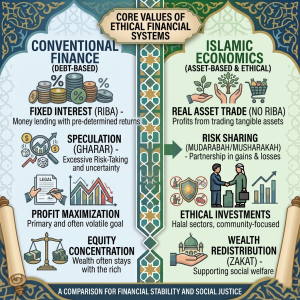
Core Principles of Islamic Economics:
Islamic economics aims to conduct financial processes in an accountable and equitable manner. It emphasizes equity, integrity, risk-sharing in asset utilization, and tangible commercial operations. Fiscal mechanisms are intended to appraise not only benefits but also their spillover effects on individuals and communities. Consequently, Islamic economics links monetary policy with ethics and inclusive prosperity.
Prohibition of Interest (Riba)
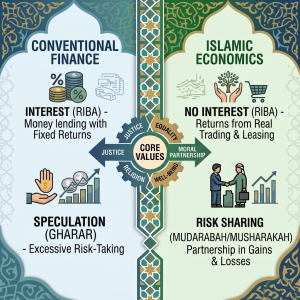
Risk Sharing
Social Justice and Wealth Distribution
Ethical Business Practices
Prohibition of Excessive Speculation
How Islamic Economics Affects a Country’s Economy
Islamic economics can impact a country’s macroeconomic system by promoting a sound economic process and the efficient utilization of resources. It focuses on equity, clarity, and risk-sharing rather than relying solely on debt-based partnerships. These mechanisms can be designed to show how firms, asset-backed entities, and financial organizations make allocations. Its comprehensive strategy also assesses public well-being alongside socioeconomic advancement and capital accumulation.
Encourages Financial Stability
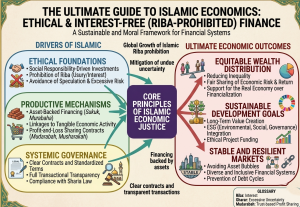
Reduces Income Inequality
Promotes Ethical Investment
Supports Small Businesses
Profit-sharing agreements have the potential to broaden access to financing for entrepreneurs facing challenges in securing conventional loans. Such arrangements have the capacity to foster creativity, generate employment opportunities, and enhance economic variety. Consider a scenario where a small business proprietor opts to collaborate with an Islamic financial entity instead of opting for a loan with exorbitant interest rates. In this scenario, mutual advantages stem from the prosperity of the business for both involved parties.
Strengthens Social Welfare
Through charitable mechanisms and community-focused financial practices, Islamic economics actively supports vulnerable populations. Stronger social welfare systems can improve education, healthcare, and overall quality of life. Furthermore, this economic model promotes financial inclusion that can provide monetary support to individuals encountering socio-economic challenges. This fosters a more socially integrated society where market prospects and resources reach a broader segment of the population.
Examples of Islamic Economic Practices:
Several countries have implemented Islamic economic principles in ways that reflect their domestic monetary frameworks and growth requirements. Malaysia, Pakistan, Bahrain, the UAE, Saudi Arabia, and other countries provide an illustration of how Islamic finance and its interconnected role are operational in empirical market conditions. Evaluating these examples facilitates understanding of how Sharia-compliant financial frameworks operate across global markets and impact national GDP.
- Malaysia stands out on the international stage as a frontrunner in the realm of Islamic finance. With a well-established Islamic banking industry, Takaful insurance services, and flourishing Islamic capital markets, the country exemplifies the seamless integration of Islamic financial tenets into a contemporary and varied economic landscape.
- The Islamic banking sector in Saudi Arabia is extensive, with numerous financial establishments providing Shariah-compliant financial products and services. Islamic beliefs heavily influence the financial rules and operational methodologies within the industry.
- Islamic finance has established itself as a significant hub in the United Arab Emirates. International investors are drawn to cities like Dubai due to offerings in Islamic banking, Sukuk, and various Shariah-compliant financial services.
- Over the past few years, Pakistan has been steadily broadening its Islamic banking industry. Efforts have been made to enhance the presence of Islamic finance within the country’s financial framework, resulting in the availability of Islamic banking windows and comprehensive Islamic banking services in numerous banks.
- In the realm of Islamic finance, Bahrain stands out as a crucial center. The nation is home to a multitude of Islamic financial establishments and actively contributes to shaping global Islamic finance protocols.
Global Sharia-Compliant Operational Footprint
Ethical and faith-based financial tools have extended across multifaceted commercial landscapes, sustaining to varied legal environments and macroeconomic conditions. Their prevalence globally reflects how Islamic finance play within a broad spectrum of international economic systems.
Core tenets / Country Foundational Methodology System-Wide Financial Footprint Value-Based Foundations Abolition of interest-bearing debt • Place interst-based Returns.
• Through physicalAsset-backed transactions.
Risk Insulation Risk and Return Sharing • Solidifies organizational transparency.
• Stabilizes fluctuations market overvaluation.
Distributive Justice Obligatory Zakat Deployment • Establishes social safety nets.
• Reconciles structural income gaps.
Institutional Behavior Information Disclosure Standards • Purging administrative corruption.
• Secures enduring public confidence.
Institutional Business Facilitation Profit-Sharing Asset • Relieves exploitative debt burdens.
• Expands entrepreneurial pathways.
Malaysia Unified Financial Models • Integrates Bancatakaful seamlessly..
• Defines global best practices.
Saudi Arabia Shariah Regulatory Compliance • Streamlines asset securitization protocols.
• Amplifies enterprise retail footprints.
United Arab Emirates Capital Accumulation Center& Sukuk • Anchors international capital deployment.
• Fortifies systemic liquidity gateways.
Pakistan Retail Banking Touchpoints Advancement • Advances domestic financial infrastructure.
•Amplifies full-scale Shariah-compliant ecosystems.
Bahrain International Regulatory Frameworks • Steers global financial governance.
• Focalizes a robust regulatory ecosystem.
Conventional vs. Islamic Economics
Conventional and Islamic economics diverge in how they monetary strategy, uncertainty, domain, and fiscal obligation. The table below main insights these distinctions via key characteristics and experience in a clear side-by-side comparison.
| Feature / Metric | Conventional Economics | Islamic Economics |
| Primary Focus | Driven basically by monetary policy, benefit maximization, and market productivity. | Pursues proportionality among economic growth, social parity, and ethical mandates. |
| Capital Yield Engine | Depends massively on loan-based shareholders and constant vs. fluctuating interest rates, Riba. | Forbids riba; capital accumulation is strictly anchored to ethical commerce and income-generating assets. |
| Risk Distribution | This model fundamentally changes the debt burden of financial uncertainty fundamentally for the debtor, irrespective of the productive outcome. | Operate on the basis of mutual risk and returns equity-based models between investors and business initiators. |
| Market Discipline | Facilitates high speculation, non-asset-backed trading, and increase-risk transactions. | This system strictly disallows predatory speculation (Gharar) and excessive uncertainty; needs physical asset backing. |
| Wealth Circulation | Allows liquid capital surplus hoarding, which can Possibly expand structural income imbalance. | It enforces compulsory fiscal capital reallocation via Zakat and voluntary charities to shelter marginalized populations. |
| Asset Correlation | Debt expansion can multiply the value of tangible products, triggering artificial shocks and economic distortions. | Funding is rigidly anchored to physical market operations value-adding sectors like producing, socio-economic networks, agricultural domains. |
Expanding Global Influence of Islamic Finance
Sharia-compliant financial practices have expanded across diverse markets, adapting to different regulatory and economic environments. This global presence shows how Islamic finance operates within a wide range of global financial systems. Its escalating coverage has generated financial links between Islamic organizations, firms, and capital providers in various parts of the world. This progress shows the adaptability of Sharia-compliant budgetary projections in supporting multifaceted commercial requirements and market frameworks. As global momentum continues to evolve, Islamic finance is becoming part of the general consensus-building about ethical and moral perspectives on capital movements.
Challenges of Islamic Economics
Islamic Economics: A Comprehensive Socio-Economic Model
Islamic economics can be grasped as more than a monetary framework shaped only for Muslims; it establishes a comprehensive ethical framework for demographic and social life. Its role centers on fairness, accountability, inherent human worth, and social prosperity. From this perspective, the related advisory benchmark within Islamic economic doctrines can be considered material to human welfare because it addresses not only capital movements but also how assets, obligations, and societal commitments are controlled.
A focal point of this model is the importance of behaving toward people with integrity and clarity irrespective of their level of wealth. Zakat provides a systematic process for moving a portion of exempt wealth to approved payees, while benevolent acts provide extra assistance for individuals encountering economic difficulty. These networks interface people’s fiscal obligations with general societal well-being and can lead to a more accessible economic landscape.
Corporate Social Responsibility may seem to start at the individualized basis, but its macroeconomic impacts can extend into societies and the economy. When resources reach people who require them, they can aid essential spending, engagement in commercial trade, and social stability. In this way, individual responsibility, charitable mechanisms, ethical business practices, and productive economic activity can cumulatively become part of an overall economic landscape.
The prohibition of interest-based transactions is another essential feature of Islamic wealth management. Rather than classifying a predetermined payoff on money as separate from the outcome of a productive enterprise, Islamic finance focuses on commerce, investor transactions, and cooperative financing mechanisms. The core philosophy is that capital gains should be linked with real market-based enterprise and the presumption of uncertainty.
Islamic economic roles also structure borders regarding exercises viewed adverse or socially corrosive, comprising speculative gaming and exchanges incorporating extreme ambiguity or forbidden practices. This generates a moral aspect within financial decisions, where economic profit is not treated as the only consideration. The conceptual scheme therefore looks for gross output with ethical integrity , welfare state, and wealth-generating activity.
These principles introduce a macroeconomic model in which economic equity, ethical accountability, moral rectitude, and tangible production are interconnected. The importance of the Islamic framework therefore surpasses the exclusion of interest alone; it also incorporates how wealth is distributed, how uncertainty is managed, and how contractual obligations are fulfilled, and economic processes impact society. This comprehensive synthesis is what makes Islamic economics a unique methodology that prioritizes stability over speculation.
Summary
Reference
The Potential Growth and Future Trends of Green Sukuk as a Tool for Sustainable

As an economics writer at Tech and Tips Economy, Siraj Ullah focuses on demystifying economic policies and financial data. His primary goal is to ensure that general economic topics are clear and easy to understand for the everyday reader. By adjusting the depth and length of his articles based on topic complexity, Siraj works tirelessly to bring approachable economic insights directly to his audience.