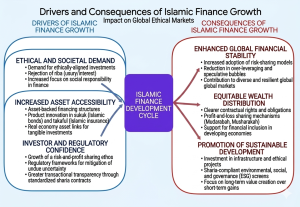
Islamic finance and banking have been experiencing significant growth and transformation, moving from a niche market segment to a prominent player in the global financial arena. Unlike traditional financial systems reliant on interest-based debt structures, Islamic banking emphasizes fair risk-sharing, complete transparency, and socially responsible allocation of resources. In the face of market volatility, debt crises, and a growing demand for ethical investment options, this alternative framework emerges as a resilient and promising way forward. This expansion is not limited to Muslim-majority countries anymore. Islamic finance, once a niche banking concept, has transformed into a significant player in the global financial landscape.
Powerful Realities: 1. Strict Prohibition of Interest (Riba) 2. Foundation on Risk and Profit-Sharing 3. Asset-Backed Financing with Material Security 4. Avoidance of Speculation (Gharar and Maysir) 5. Ethical Constraints and Halal Investment Practices
Powered by Google Gemini
Exploring the Realm of Islamic Finance and the Expansion of Islamic Banking
Islamic finance stands out for its unique structure that forbids monetary capital from accruing wealth unless it is linked directly to tangible and productive economic endeavors. At its core, this system prohibits interest (Riba) and instead promotes asset-backed trade, strategic partnerships, transparent leasing arrangements, and cooperative equity sharing in place of traditional lending practices. By adopting this framework, financial institutions are compelled to integrate themselves into actual economic sectors, moving away from passive lending roles. Such a fundamental ideology significantly propels the worldwide advancement of Islamic banking.
In the realm of global markets:
Embracing the quest for sustainable options in lieu of debt-laden investments, the distinctive interest-free framework of this model remains a key factor in bolstering investor trust. The exponential surge of Islamic banking today is underpinned by its ability to harmonize moral standards with strong financial returns in Eastern and Western sectors alike. Prioritizing equitable practices and tangible asset generation over mere speculative transactions, the continuous expansion of Islamic banking emerges as a potent, revolutionary influence within the contemporary worldwide financial landscape.
The core principles of Islamic finance include:
– Riba prohibition – Mitigation of undue uncertainty – Sharing of risks and profits – Financing backed by assets – Investments based on ethics and social responsibility – Clear contracts and transparent transactions
These principles aim to create a fair and balanced financial system that benefits both investors and society.
The Historical Development of Islamic Banking
The Growth of Islamic Banking
In the 1960s, the inception of modern Islamic banking took place through small experimental initiatives. Gradually, this sector evolved into a global financial powerhouse with assets surpassing trillions of dollars. Presently, Islamic banks are operational in various nations spanning the Middle East, Asia, Africa, Europe, and North America. Countries like Malaysia, Saudi Arabia, the United Arab Emirates, Pakistan, and Bahrain have emerged as leaders in the domain of Islamic banking. Additionally, financial hubs such as the United Kingdom and Luxembourg have introduced Islamic financial instruments to allure international investments. The growing recognition of Islamic banking indicates that its allure transcends mere religious affiliations. Numerous investors perceive Islamic finance as a reliable and principled substitute to traditional financial models.
Reasons Behind the Growth of Islamic Banking:
1. Rising Demand for Ethical Finance
The ethical principles of Islamic banking resonate with modern consumers who prioritize knowing how and where their funds are utilized. Unlike conventional banking, Islamic banking adheres to strict guidelines that restrict investments in sectors like gambling and alcohol which are deemed detrimental to society. This ethical banking model attracts customers from diverse backgrounds, including both Muslim and non-Muslim individuals, who are looking for socially responsible financial options.
2. Increased Financial Stability
Islamic banking is often hailed for its resilience during the global financial crisis of 2008, illuminating the vulnerabilities of heavily leveraged financial structures. Unlike their conventional counterparts, Islamic banks prioritize tangible asset-backed transactions over speculative ventures, a strategy that is perceived by numerous experts as a potential enhancer of financial security.
3. Growing Muslim Population
The rising global Muslim community has led to a growing need for financial products that adhere to Shariah principles. More and more individuals and businesses are seeking financial solutions that resonate with their spiritual beliefs.
4. Government Support
Numerous governmental bodies worldwide have implemented regulatory structures and strategies aimed at promoting Islamic finance. Such endeavors have played a crucial role in drawing investments and enhancing trust in Islamic financial entities.
5. International Investment Opportunities
Global investors have shown increasing interest in Islamic financial instruments such as Sukuk, which provide access to infrastructure projects and long-term investments while complying with Islamic principles.
Main Islamic Banking Products
Islamic financial institutions provide a range of services tailored to cater to the requirements of individuals, enterprises, and governmental bodies.
Murabaha (Cost-Plus Financing)
Under Murabaha, the bank purchases an asset and sells it to the customer at a predetermined profit margin. This method is widely used for vehicle financing, equipment purchases, and business investments.
Musharakah (Partnership Financing)
In a Murabaha arrangement, a financial institution acquires an asset and then resells it to the client at a set profit margin. This practice is commonly employed in transactions involving vehicle procurement, equipment acquisition, and entrepreneurial ventures.
Mudarabah (Profit-Sharing Agreement)
Within a Mudarabah contract, one entity contributes funds, and the other oversees the operational aspects. The distribution of profits is based on a pre-established proportion.
Ijara (Islamic Leasing)
Customers can utilize assets owned by the bank through Ijara in return for lease payments, making it a popular choice for property and equipment financing.
Sukuk (Islamic Bonds)
Sukuk, unlike traditional bonds, offer ownership stakes in physical assets or ventures, resulting in profits derived from business endeavors rather than interest earnings.
Economic Impact of Islamic Banking
Islamic banking plays a significant role in fostering economic growth through various essential means.
Promoting Financial Inclusion
Islamic banking allows millions of individuals to engage in the formal financial system by addressing their worries about interest, thus promoting financial inclusion and enhancing economic involvement.
Supporting Entrepreneurship
By implementing profit-sharing mechanisms, banks are incentivized to make direct investments in businesses and entrepreneurial projects, thus fostering innovation, creating job opportunities, and driving economic expansion.
Encouraging Productive Investments
Capital is channeled into productive sectors like manufacturing, agriculture, transportation, and housing in Islamic finance due to its requirement for transactions to be backed by tangible assets.
Reducing Excessive Debt
By disallowing interest and speculative deals, it is possible to mitigate excessive borrowing and promote a culture of prudent financial conduct.
Infrastructure Development
Sovereign entities commonly utilize Sukuk as a means to fund extensive ventures like highways, airports, hospitals, schools, and energy infrastructures, thereby bolstering sustained economic development.
Challenges Facing Of Islamic Banking
Islamic banking, despite its remarkable growth, encounters various structural hurdles. A key obstacle lies in the lack of awareness among potential clients, as many individuals do not grasp the functioning of Islamic financial products. Furthermore, discrepancies in Shariah interpretations among different nations can lead to inconsistencies in financial operations. Islamic banks also contend with fierce competition from traditional financial institutions that boast larger customer bases and greater resources. Additionally, the industry necessitates more professionals well-versed in both contemporary finance and Islamic law. Embracing technological advancements poses yet another trial, compelling Islamic banks to persist in their investments in digital banking services, mobile apps, and financial technology advancements to stay competitive.
The Future of Islamic Finance in the Modern Economy
The promising outlook for Islamic finance is becoming increasingly evident. Thanks to rapid technological progress, a rising desire for ethical investment options, and a growing focus on sustainable finance, new avenues for growth are being unlocked. Islamic FinTech, digital banking solutions, and Green Sukuk represent pivotal sectors experiencing notable development. By harmonizing modern technology with Islamic financial principles, these advancements enhance the accessibility and efficiency of financial services. For further insights, delve into
Economic experts assert that the integration of Islamic finance could enhance the stability of the worldwide financial system through promoting ethical investments, curbing unwarranted speculation, and reinforcing the connection between financial activities and tangible economic sectors.
Closing Remarks
Islamic finance, once a niche banking concept, has transformed into a significant player in the global financial landscape. With its core principles of ethical investment, risk-sharing, transparency, and asset-backed funding, it has garnered increasing attention from investors and policymakers worldwide. The remarkable ascent of Islamic banking underscores that financial prosperity can align harmoniously with robust ethical values. In a world where sustainable and socially responsible financial mechanisms are in demand, Islamic banking is poised to assume a pivotal role in fostering economic development, financial inclusivity, and enduring financial security. The expanding footprint of Islamic finance underscores its potential to emerge as a key influencer in the future trajectory of the global banking sector.
Siraj Ullah, an economics writer at Tech and Tips Economy, specializes in elucidating intricate economic concepts through concise data and tailored infographics for enhanced reader comprehension. Drawing on expertise in global macroeconomics and fiscal policy, his mission is to demystify international finance, making it more visual and approachable to a wider audience.