
Table of Contents
Shaping Economies and Global Significance: The Impact of Monetary Policy
About The Monetary Policy
In the realm of financial governance, monetary policy encompasses the measures implemented by a nation’s central bank to regulate the money supply and interest rates within the economy. Typically, the overarching goal is to uphold price stability while fostering economic expansion. To illustrate, in the United States, the Federal Reserve fulfills the role of the central bank, whereas the State Bank of Pakistan serves as Pakistan’s central banking authority.
Quick Comparison Table:
The central bank in the United States is the Federal Reserve (with a current target range of 3.50%–3.75%), while the central bank of Pakistan is the State Bank of Pakistan (with a current policy rate of 11.50%). The various policy rates are due to the varying economic conditions and monetary problems in the two countries. The interest rate of a policy rate may affect savings incentives, borrowing costs, investment choices and overall economic demand. The two can be compared to give an understanding of the different methods central banks might use depending on the state of the domestic economy. These variations should then be understood in the context of the overall inflation, growth and financial situation of each country.
| Central Bank | Current Policy Interest Rate | Last Meeting Action | Next Scheduled Review |
|---|---|---|---|
| Federal Reserve (US) | 3.50% – 3.75% | Held Steady (June 17, 2026) | July 29, 2026 |
| State Bank of Pakistan (SBP) | 11.50% | Held Steady (June 15, 2026) | Late July / August 2026 |
Banks Generally Use Monetary Policy:
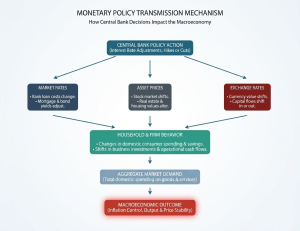
Monetary policy plays a crucial role in managing various economic factors, including inflation control, support for economic growth, financial stability maintenance, unemployment reduction, and national currency stabilization. Central banks utilize a range of tools to impact economic activity significantly.
Interest Rates
Central banks wield significant influence through interest rates. If inflation spikes, they might hike interest rates to curb it by upping borrowing costs, which in turn curtails spending and investment, aiding in inflation control. Conversely, when economic growth falters, central banks could opt to slash interest rates to stimulate borrowing and spending.
Money Supply
Central banks can impact economic process by realigning the availability of money and credit in the financial system. High liquidity can support spending and investment, while reducing it can help moderate demand and inflationary pressure. Liquidity changes may affect the availability of funds to finance household and business spending and investment. The increased liquidity could stimulate transactions and bolster demand when the economy is sluggish. If the money supply expands too rapidly, however, it can put additional pressure on prices if it expands faster than the economy’s productive capacity. So, it is essential to take into account the economic environment when dealing with liquidity management.
Open Market Operations
Buying and selling government securities by central banks is a strategy employed to impact liquidity within the banking system, thereby controlling short-term interest rates and broader financial conditions. When a central bank buys bonds, it can infuse finance into the economic system and ensure highly accessible marketability Selling securities can have the adverse effect of absorbing liquidity from the financial sector. These functions can therefore impact the accessibility and cost of short-term funding. Via such interventions, authorities can react to shifting economic situations and sustain greater control over monetary supply volumes.
Advantages of Monetary Policy Implementation
Implementing a thoughtfully crafted monetary policy can yield substantial advantages. It can shape borrowing and spending, saving and investment decisions, thereby helping to shape the policy responses to changing economic conditions. An appropriate policy stance can also help prevent instability and unwarranted swings in economic activity as well as price dynamics. Fiscal policymaking that is well-tuned to economic conditions can help create a more stable policy climate for business and households.
- Businesses and households can effectively strategize for the future when prices remain stable. Maintaining control over inflation safeguards purchasing power.
- Encouraged by reduced interest rates, businesses may be prompted to grow, embark on fresh ventures, and increase their workforce.
- The growth of the economy frequently leads to the generation of fresh employment opportunities and a decline in unemployment figures.
Risks of Poor Implementation
A failure to properly manage central banking structures can lead to a failure in structural growth and cause risks in the market system. When the economy is already struggling, inconsistent monetary policies can instill uncertainty into businesses, investors, and households. A failure to correctly estimate the rate of inflation or financial demand can also result in imbalances that will be more difficult to rectify in the long term. Such vulnerabilities also can impair trust in financial institutions and future economic adjustment.
- Poor management of inclusive social welfare can lead to severe economic issues, dissuading investors from putting their money in countries lacking predictability and transparency in their monetary policies.
- Excessive inflow of money into the economy can lead to a rapid increase in prices, subsequently diminishing consumers’ buying capacity and fostering an atmosphere of uncertainty.
- Elevated interest rates have the potential to hinder both spending and investment, thereby heightening the likelihood of an economic downturn.
- Poor handling of monetary affairs can lead to abrupt changes in currency values, complicating global commerce.
- In a scenario where interest rates remain unusually low over a prolonged duration, investors might be inclined towards venturing into riskier assets, potentially leading to the formation of bubbles within housing or stock markets.
Global Impact of Monetary Policy
The globalized nature of today’s world means that the monetary policies of leading economies have far-reaching impacts across nations. Whenever the United States decides to increase interest rates, investors tend to redirect funds into American financial markets in pursuit of better profits. Consequently, this can trigger a shift of capital away from developing economies like Pakistan, India, or Brazil. Likewise, the choices made by key economic hubs have extensive repercussions on worldwide trade, investment patterns, and currency values. Therefore, central banks now pay closer attention to global events while formulating their policy measures.
Countries Known for Strong Monetary Policies
There are a number of countries that are renowned for their ability to deal with the monetary affairs. They tend to watch financial developments, employment conditions, economic growth and inflation when making monetary decisions, making inflation monitoring a central focus of their central banks. For example, in the U.S., Germany, Japan, and the U.K., countries have various economic examples that illustrate the way monetary authorities react to changing economic conditions.
- Switzerland receives accolades for its ability to uphold minimal inflation rates and financial steadiness.
- The country’s central bank is highly regarded for its credibility and prudent policymaking.
- Singapore has effectively blended fiscal prudence with robust economic expansion, positioning its financial framework as among the most secure globally.
- The United States continues to hold the position of being the largest economy globally.
- The choices put forth by the Federal Reserve have a significant impact on worldwide financial markets and the flow of international capital.
- Despite being subject to the monetary policy set by the European Central Bank, Germany’s steadfast adherence to financial discipline has propelled it to become one of the most robust economies in Europe.
Countries Leading the Global Economy
Several nations currently play dominant roles in the world economy. Their impact comes from a convergence of macroeconomic magnitude, maximum output threshold, global trade flows, capital stability, and technological innovation. These aggregate fiscal systems can affect global markets through shifts in business investment, domestic expenditure, import-export volumes, and the market liquidity environment. Their investment strategies may also generate outcomes that surpass their local markets. Evaluating these countries explains how basic national marketplaces add to the orientation of the international economic order. Learn more about rapidly developing nations: The United States and China stand out as the primary engines shaping worldwide macroeconomic trajectories, transnational capital flows, and international trade networks.
| Country | Key Strength |
|---|---|
| United States | Technology, finance, innovation |
| China | Manufacturing and exports |
| Germany | Industrial production |
| Japan | Advanced technology |
| India | Fast-growing consumer market |
| Singapore | Trade and financial services |
Monetary Policy in Pakistan
A Critical View of the Monetary Policy Framework
After examining the role of interest rate policy throughout this article, a crucial question arose: should the regulatory authority itself be evaluated as an indicator of a country’s economic performance? Credit strategy is clearly a structure utilized to impact currency, loans, assets, purchasing power, and economic circumstances. It should not be treated as a straightforward indicator of state growth and wealth expansion, which is shown through aggregate measures like output efficiency, job creation, business investment, revenue, trade flow, production, and upgrades in lifestyle.
The choice between expansionary and contractionary strategies can generate significant financial impact. Reflationary policies may promote lending, consumption, and capital allocation by mitigating fiscal strain, whereas deflationary policies may limit demand when an upward price trajectory becomes a primary concern. These influences show that the central bank mandate can direct the momentum of business dynamics. However, the policy mechanism itself should not be confused with the sustainable prosperity it is intended to influence.
Questioning the Interest-Based Framework
A deeper issue underlies the anxieties surrounding the inextricable link between conventional policy and interest-based systems. Real interest rates furnish central banks with a framework to influence lending, retained capital, business investment, and demand, but entrenched dependency on debt-based lending can also generate capital stringency for debtors. This raises a wider question about whether liquidity regulation must perpetuate reliance on fixed rates or whether a substitute model could achieve some of the same operation through diversified financial frameworks.
The central banks achieve a critical alignment framework within conventional systems. Their strategic decisions influence liquidity, lending standards, and market rates throughout the banking sector. Monetary policy provides commercial banking networks with an essential reference point when determining their internal capital allocation and interest rates. Without integrated, productive institutions, credit providers could face greater risk in setting financial conditions, potentially creating wider scope of macroeconomic instability across the economic system.
Monetary Policy Is Not a Complete Measure of Economic Health
While monetary policy decisions can give some clues on the economic pressures the policy makers are trying to address, they cannot capture the full picture of the economic situation. The national economic performance is broader and includes inflation, employment, productivity, investment, exports, public finances, income and economic output. Thus, the use of monetary policy is seen as one element of economic management – not the only element to measure the progress of an economy.
This discussion provides an opportunity to examine whether the monetary functions can be accomplished in the future through a different regulatory regime or be better integrated with the broader fiscal and economic policies. This does not have to involve giving up the concept of financial coordination, but it could aim to achieve monetary stability alongside less reliance on interest-based financing. Productive investment, real economic activity, asset-based transactions, risk sharing and sustainable financial relationships could be emphasized.
The main point derived from this debate is that the requirement for macroeconomic convergence and the interest-based model utilized to reach it are separate problems. Policy integration can remain critical for sustaining a cohesive economic infrastructure, whereas the foundational matrix can still be reviewed and revised. An emerging financial model could therefore seek to maintain efficiency, policy, and collaboration while affording prominence to value-added activity, fiscal soundness, and the wider socioeconomic health of the collective.
Final Results
References & Best Information

As an economics writer at Tech and Tips Economy, Siraj Ullah focuses on demystifying economic policies and financial data. His primary goal is to ensure that general economic topics are clear and easy to understand for the everyday reader. By adjusting the depth and length of his articles based on topic complexity, Siraj works tirelessly to bring approachable economic insights directly to his audience.
Good