
Table of Contents
Background and Context: Growth of Islamic Banking
Powerful Realities:
1. Strict Prohibition of Interest (Riba)
2. Foundation on Risk and Profit-Sharing
3. Asset-Backed Financing with Material Security
4. Avoidance of Speculation (Gharar and Maysir)
5. Ethical Constraints and Halal Investment Practices
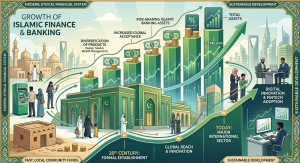
Exploring the Domain of Islamic Finance and the Expansion of Islamic Banking
Islamic finance stands out for its unique structure that forbids monetary capital from accruing wealth unless it is linked directly to tangible and productive economic endeavors. At its core, this system prohibits interest (Riba) and instead promotes asset-backed trade, strategic partnerships, transparent leasing arrangements, and cooperative equity sharing in place of traditional lending practices. By adopting this framework, financial institutions are compelled to integrate themselves into actual economic sectors, moving away from passive lending roles. Such a fundamental ideology significantly propels the worldwide advancement of Islamic banking.
In the Sphere of global markets:
The core principles of Islamic finance include:
These principles aim to create a fair and balanced financial system that benefits both investors and society.
- Riba prohibition
- Mitigation of undue uncertainty
- Sharing of risks and profits
- Financing backed by assets
- Investments based on ethics and social responsibility
- Clear contracts and transparent transactions
The Roots of Shariah-Compliant Finance
Islamic banking has evolved gradually as capital requirements and economic activity have shifted over time. Its underlying causes can be attributed to Islamic principles that highlight impartiality, ethical trade flows, collective accountability, and the mitigation of conflicts of interest. From early forms of trade and collaborative ventures to present-day monetary entities, these principles have perpetually influenced Islamic finance. The growth of Islamic banking has also been driven by shifting customer needs and the search for substitute financial mechanisms. Today, Islamic banks operate globally and offer a range of Shariah-compliant fiscal solutions. Grasping this evolutionary timeline helps determine how Islamic banking has developed into a critical part of the contemporary financial system.
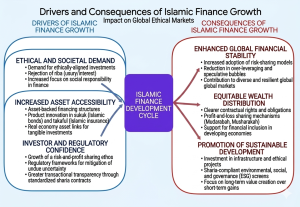
The Growth of Islamic Banking
Countries like Malaysia, Saudi Arabia, the United Arab Emirates, Pakistan, and Bahrain have emerged as leaders in the domain of Islamic banking. Additionally, financial hubs such as the United Kingdom and Luxembourg have introduced Islamic financial instruments to allure international investments.
The growing recognition of Islamic banking indicates that its allure transcends mere religious affiliations. Numerous investors perceive Islamic finance as a reliable and principled substitute to traditional financial models.
Reasons Behind the Growth of Islamic Banking
The growth of Islamic banking has been influenced by multiple economic, social, and capital dynamics. Many consumers are engaged in financial services that follow Islamic principles while also meeting their daily banking needs. The increasing public understanding of Shariah-compliant finance has empowered agents, firms, and organizations to scrutinize these substitutes. Consequently, Islamic banks have augmented their products and services to react to shifting market situations. Global interest in ethical and asset-based financial operations has also added to the widespread proliferation of this sector. Together, these factors have facilitated Islamic banking’s robust prevalence in contemporary financial markets.
Rising Demand for Ethical Finance
Increased Financial Stability
Growing Muslim Population
The rising global Muslim community has led to a growing need for financial products that adhere to Shariah principles. More and more individuals and businesses are seeking financial solutions that resonate with their spiritual beliefs. This burgeoning demand has prompted financial corporations to better accommodate the preferences of Muslim consumers. It has also generated options for Islamic banks to meet current market needs and diversify service offerings for clients. As financial literacy regarding Shariah-compliant frameworks expands, consumers are gravitating toward understanding how these financial modalities operate. This widespread traction is driving the wider development and market cognizance of Islamic banking in various parts of the world.
Government Support
International Investment Opportunities
Main Islamic Banking Products
Murabaha
Musharakah
Musharakah is an Islamic agreement founded on shared risk, in which two or more parties pool resources into a firm, program, or business investment. The co-venturers share the capital stake and partake in the financial results of the enterprise. Benefits are allocated Pursuant to a mutually prescribed ratio, where losses are exclusively assumed consistent with each participant’s capital provision. Unlike interest-based lending, Musharakah links funding with stakeholder engagement and economic activity. It can be utilized for collaborative operations, real estate acquisitions, and other equity participation where the entities reciprocally assent to share the risks and returns.
Mudarabah
Ijarah
Sukuk
Economic Impact of Islamic Banking
- Islamic banking allows millions of individuals to engage in the formal financial system by addressing their worries about interest, thus promoting financial inclusion and enhancing economic involvement.
- By implementing profit-sharing mechanisms, banks are incentivized to make direct investments in businesses and entrepreneurial projects, thus fostering innovation, creating job opportunities, and driving economic expansion.
- Capital is channeled into productive sectors like manufacturing, agriculture, transportation, and housing in Islamic finance due to its requirement for transactions to be backed by tangible assets.
- By disallowing interest and speculative deals, it is possible to mitigate excessive borrowing and promote a culture of prudent financial conduct.
- Sovereign entities commonly utilize Sukuk as a means to fund extensive ventures like highways, airports, hospitals, schools, and energy infrastructures, thereby bolstering sustained economic development.
Challenges Facing Islamic Banking
The Future of Islamic Finance in the Modern Economy
Islamic Banking and Broader Economic Well-Being
From an economist’s perspective, Islamic banking seems to provide a more prudent strategy for economic activity because it caters to the requirements of both retail consumers and large institutional clients. A process that prohibits riba and links funding with actual trade flows, asset-backed investment, and shared risk may generate a profound nexus between financial operations and the physical market. When individuals and corporations are not perpetually strained by compounding finance charges, more of their financial backing might remain commercially accessible for capital allocation, business growth, and wealth-creating ventures.
This viewpoint also provides insight into an ethical financial framework that qualifies for a broader scope. Aggressive financing charges can impose substantial liquidity stress on liability holders, specifically when debt servicing persists to increase whereas revenue or firm progress remains poor. Islamic banking permits alternative models in which commercial arrangements are founded on formalized settlements, equity-based cooperation, or sukuk endeavors rather than traditional lending.
The comprehensive framework is not constrained to one religion or one socioeconomic entity. Market participants with varied schools of thought can evaluate Islamic banking within their own fiscal and monetary climates and analyze whether its policies and instruments deliver actionable returns. A larger global profit share in such a structure could prompt further advancement, integration, and growth within the international financial infrastructure.
As a comprehensive analysis, Islamic banking as a financial policy warrants further investigation regarding integrity-based settlements, productive pursuits, and mutual economic liability. Its expected provision should be assessed through real economic progress, consumer experience, and the viability of its financial frameworks rather than via faith-centric parameters alone.
Islamic Banking as a Complete Financial Package
When the financial products presented via Islamic banking are interpreted together, they reflect a broad economic process shaped to encompass a diversity of economic requirements. Asset-backed trade transactions, profit-and-loss sharing framework, trust investment and partnership framework, Shariah-compliant leasing model, and trust certificates each serve distinct economic objectives, permitting diverse financial instruments to accommodate choices from daily personal requirements to firm activities, investment, and large-scale programs.
This spectrum of instruments gives Islamic banking context at multiple economic strata. A person may need funding for a personal asset, a firm may require capital for growth, and a macro-financial entity may secure financing for a comprehensive development venture. Different Islamic Shariah-compliant arrangements can accommodate these varied regulatory mandates while preserving financial flexibility for operational pursuits, such as verifiable assets, trade flows, business investment, or risk sharing.
From an economic thinker’s perspective, this diverse spectrum endows Islamic banking with attributes of a complete financial model rather than a specialized banking system. Its productivity can therefore be acknowledged across individuals, firms, financial corporations, and regulators. The operational efficacy of a model crucially hinges on how competently its financial contracts are enforced, monitored, and utilized within the broader economy.
Comparison Matrix of Conventional and Islamic banking Product
This comparison matrix pinpointed to the key differences between conventional and Islamic banking products widespread financial requirement. It emphasizes on their core mechanisms, funding structures, and the way every system delivers monetary instruments to persons and businesses
| Core Sector | Conventional Products | Shariah Instruments | Key Advantage & Macro Impact |
| Commercial | Interest–Bearing Loans • Debt and lending obligations involving compounded usury | Murabaha • A cost-plus financing framework structured around transparent trade transactions | Islamic Finance Advantage: • promote productive trade flows and mitigate synthetic debt creation. |
| Business | Corporate Bonds • Capital mobilization through interest-bearing debt instruments, shifting financial risk entirely to the borrowing enterprise | Musharakah • An equity-based partnership model structured on a profit-and-loss sharing framework. | Islamic Finance Advantage: • Supports micro-level proprietorship and mitigates market uncertainty. |
| Assets | Conventional Lease • An interest-bearing arrangement where compounded usury is charged on the capital advanced | Ijarah • An asset-backed lease arrangement where rental charges are generated strictly based on asset utilization | Islamic Finance Advantage: • Mitigates excessive financial leverage while ensuring ownership risk remains with the institution. |
| Capital | Fixed-Income Debt • Instruments backed by sovereign credit with no physical asset collateralized. | Sukuk • Shariah-compliant investment certificates representing fractional shares of ownership in tangible projects. | Islamic Finance Advantage: • Facilitates both direct and indirect structural cohesion within macroeconomic frameworks and productive economic processes |
Closing Remarks
References

As an economics writer at Tech and Tips Economy, Siraj Ullah focuses on demystifying economic policies and financial data. His primary goal is to ensure that general economic topics are clear and easy to understand for the everyday reader. By adjusting the depth and length of his articles based on topic complexity, Siraj works tirelessly to bring approachable economic insights directly to his audience.