
Table of Contents
Analyzing the Consequences of Recent Turmoil in the Middle East and Worldwide Oil Crisis:
Despite the diversification of global markets in recent years, petroleum continues to play a crucial role in the modern industrial landscape, influencing international trade and daily transportation. History illustrates that any turmoil in energy-producing regions can swiftly lead to significant global oil shocks, disrupting financial stability worldwide. The recent geopolitical tensions in the Middle East have once again highlighted these vulnerabilities, causing concerns over supply chain disruptions and fluctuating prices. The sudden increase in crude oil prices still has the potential to trigger inflation, raise manufacturing costs, and hinder consumer purchasing power. This persistent volatility emphasizes the close connection between energy security, regional peace, and global economic well-being.
Why Global Oil Shocks and Rising Petroleum Prices Occur During Conflicts:
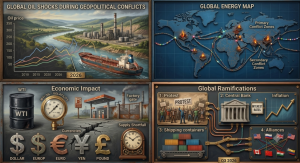
Exploring Global Oil Shock Phenomenon
Global oil shocks manifest as rapid spikes in oil prices triggered by sudden disruptions in supply, geopolitical conflicts, military confrontations, or unexpected surges in demand. Throughout history, these oil shocks have wielded substantial impacts on the world economy. Such disruptions can raise energy costs across transportation, manufacturing, trade, and other petroleum-dependent sectors. Higher oil prices may also increase household expenses and place additional pressure on business operating costs. Oil-importing economies can face greater external payment burdens, while oil-producing nations may experience changes in export earnings. The broader economic consequences depend on the duration of the shock, the scale of the supply disruption, and each country’s level of dependence on petroleum.
Top Main Geopolitical Challenges Impacting Global Markets
In today’s interconnected world, geopolitical tensions are significantly impacting trade dynamics, prompting investors to reassess the security of their assets amidst disruptions in supply chains. The collision of dominant global players can swiftly alter currency rates and trigger pervasive inflationary pressures. Recognizing these fundamental risks is crucial for anticipating emerging patterns in the global business landscape and adeptly navigating through widespread market turbulence.
Escalating Middle East Tensions and the Unpredictability of Oil Markets-US-Israel-Iran Conflict
Heightened friction in the Middle East can generate unpredictability in global oil markets because the region plays a crucial role in worldwide energy reserves and supply lines. Any dispute concerning influential regional states can escalate worries about threats to supply chains, provoking petroleum merchants and firms to respond to evolving anticipations. Surging unstable crude prices will then be able to increase transport costs and output costs in countries that rely heavily on imported fuel. The financial impact may spread outside the area, affecting purchasing power, household costs, firms’ costs, and overall market certainty. This reflects how global political animosities can rapidly evolve into systemic economic vulnerabilities when power and fuel markets become uncertain.
The Ongoing Russia-Ukraine Conflict and its Ramifications on European Energy Security
Global energy supplies faced disruption due to the Russia-Ukraine conflict, causing crude oil prices to surge over $120 per barrel at times. This led to increased fuel and food costs in numerous countries, highlighting the significant impact of geopolitical risks on oil markets.
The Russia-Ukraine conflict generated severe hurdles for Europe’s energy independence by disturbing deep-rooted delivery paths and rising unpredictability in fuel markets. European countries encountered expensive power and greater strain on reliable sources of natural gas and oil. These events also changed consumer spending, intermediaries, and firms by high functioning and maintenance costs of life. For many European macroeconomic frameworks, the sudden power crisis led to severe price hikes and shaped extra problems for the economic progress. The warfare therefore displayed how global strategic turbulence in one territory can spread outside the war zone and generate broader economic fallout globally.
Tensions in US-China Trade Relations
Rising trade disputes between the United States and China can destabilize global trade networks because both countries play major roles in international trade and production. Shifts in tariffs, trade penalties, or technology restrictions can disrupt the flow of goods and key components across borders. Firms may face higher manufacturing costs or distribution problems when access to critical materials and goods is restricted. These disruptions can also affect consumer prices and financial commitments in other economies linked to cross-border trade flows. Consequently, ongoing US-China tariff standoffs can create financial difficulties that extend beyond the two countries and inject further policy unpredictability into cross-border capital markets.
The 1973 Oil Crisis
In 1973, Arab oil-producing countries reduced oil exports due to geopolitical conflict. Oil prices surged dramatically, creating inflation and economic slowdown across severals emerging economies.
The crisis was created in the aftermath of the Yom Kippur War, launched a military offensive against Israel on October 6, 1973. As the United States sent weapons and troops to Israel, Arab oil-producing countries utilized oil exports as economic and political tools. In October, OAPEC members declared supply reductions and a commercial blockade against the United States and some other countries helping Israel. These actions cut down the accessibility of oil in global markets and exerted significant strain on oil-importing economies.
The impacts seeped into oil prices, and surging power outlays inflated the cost of supply chain conveyance, production, and other oil-reliant activities, imposing severe hardships on consumers and businesses. The crisis also played a pivotal role in driving inflation and economic hardships in oil-importing countries, while oil-producing states expanded their monetary dominance through increasing petroleum revenues. The episode showed how geopolitical tension can escalate via fuel markets and influence economic situations far beyond the countries directly impacted.
The Gulf War (1990)
The threat posed to global oil supplies by Iraq’s invasion of Kuwait in 1990 caused crude oil prices to double rapidly, causing financial markets to become highly uncertain.
Iraq’s military attack against Kuwait on August 2, 1990, instigated imminent anxieties about the integrity of production facilities and exports from the Gulf area. The geopolitical volatility disrupted resource distribution from two significant oil-producing countries and deepened concerns that the restriction could cascade through other parts of the region. As instability grew, global oil markets responded quickly, and escalating energy costs placed extra pressure on countries that relied on imported petroleum.
This effect was not restricted to the oil market. Aggravated fuel inflation raised costs for logistical transit systems, manufacturing, and other oil-reliant industries, while global markets encountered amplified volatility due to the systemic economic distress caused by the tension. The episode showed how regional military conflicts and strategic standoffs can sharply impact global power markets and propagate macroeconomic stress to countries far beyond the directly assailed territory.
Economic Effects of Rising Petroleum Prices
Increasing petroleum prices can impact almost every part of an economic system because they are intimately linked with transportation, production, and trade flows. Upward fuel costs drive up business expenses, which may subsequently raise the prices of goods and services for buyers. Countries that depend heavily on imported oil may also encounter intense strain on their trade balances and foreign exchange reserves. Surging energy expenses can decrease domestic consumers’ buying power and make it more difficult for firms to sustain profitability. Consequently, a rapid surge in fuel prices can generate widespread inflationary and economic stress.
Inflation
Increased petroleum costs lead to elevated expenses for transportation and manufacturing. Typically, these additional costs are transferred to customers in the form of increased prices. For instance, a surge in fuel costs results in a rise in the expenses associated with shipping food, clothing, and various goods. Consequently, this factor contributes to a general inflationary trend.
Surging fuel and power overheads can also increase the operating expenses of firms that rely heavily on petroleum-based inputs. When these higher costs are distributed throughout various segments, they can place extra stress on the general price level of an economy.
Slower Economic Growth
Increased oil prices lead to higher expenditures for fuel and energy within households, consequently reducing their available funds for purchasing other goods and services. This decline in consumer spending has the potential to decelerate economic growth.
When households spend more of their income on energy resources, they may have less available for daily utilization. Reduced demand for goods and services can impact firms’ revenue and may force companies to cut production or suspend scaling operations. Surging energy expenses can also raise operating costs for businesses, generating extra stress on investment and job creation. If these effects persist over a prolonged period, they can contribute to an economic downturn and decelerating economic growth.
Higher Manufacturing Costs
Petroleum products are vital for industries like chemicals, plastics, aviation, and logistics, with their heavy reliance on them. The escalation of oil prices escalates operational costs and shrinks profit margins.
When petroleum becomes more costly, firms may have to spend more on transit, energy, raw materials, and other output activities. These extra overheads can make it difficult for companies to sustain their current prices and earning power. Occasionally, elevated running costs may be passed on to buyers via increased rates for goods and services. Industries with deep dependency on petroleum can therefore experience intense economic pressure when international oil prices persist at higher levels for a longer duration.
Pressure on Public Budgets
Numerous emerging nations offer fuel price subsidies as a means of shielding consumers. As global oil prices surge, governments find themselves compelled to allocate greater funds toward subsidies, thereby amplifying fiscal strain.
When global oil prices remain high, sustaining these incentives can become increasingly costly for governments. Surging welfare and aid allocations may decrease the funding available for other public necessities, like critical infrastructure, education, healthcare, and development projects. In countries presently enduring depleted public funds, protracted surges in oil prices can therefore generate extra pressure on government budgets. The overall financial impact depends on the size of the subsidy program, domestic fuel prices, and the government’s capacity to absorb energy costs.
Global Oil Shocks Which Countries Were Most Affected?
The repercussions of heightened petroleum prices differ greatly during worldwide oil shocks, depending on a nation’s reliance on imported oil or its earnings from local energy production.
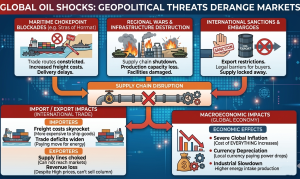
Oil-importing countries generally face stronger financial pressure when international petroleum prices rise because they must spend more on energy imports. Higher import bills can weaken trade balances, increase production and transportation costs, and place additional pressure on consumers. In contrast, oil-producing countries may receive greater export revenues when prices increase, although their economies can also face challenges if they depend heavily on petroleum income. The overall impact therefore depends on each country’s energy structure, import dependence, domestic production, and ability to manage sudden changes in global oil prices.
Net Oil-Importing Countries
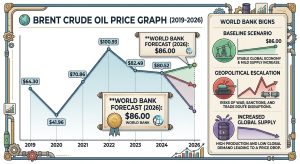
Countries with emerging economies heavily dependent on oil imports encounter significant economic hurdles in times of energy crises. The likes of India, Pakistan, and various nations in Africa and Europe witness a sudden escalation in their import expenditures, leading to depletion of foreign reserves, depreciation of domestic currencies, and a spike in inflation rates. Consequently, the elevated prices of petroleum products have a direct impact on the affordability of essential commodities, food staples, and basic services in these regions.
| Year | Brent Price (USD) | Macroeconomic Trend Analysis | critical International Developments |
| 2019–2021 | 42.3 – 70.4 | Varying from strong import dependence to slow demand revival | COVID-19 and Global Market Revival |
| 2022–2024 | 80.7 – 99.8 | Acute energy-expense strain, high import bills, and reliable foreign procurement | Russia-Ukraine Geopolitical Shocks |
| 2025–2026* | 69.0 – 86.0 | A decline in market spending followed by elevated energy-cost apprehensions | Middle East & Strait of Hormuz Tension |
Net Oil-Exporting Countries
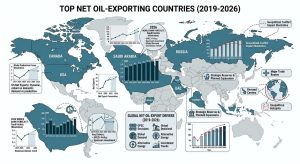
Major oil-exporting countries like Saudi Arabia, the UAE, and Qatar in the Middle East, as well as global exporters such as Canada, reap significant financial rewards from the surge in petroleum prices. This uptick in income enables these nations to finance infrastructure developments, drive economic expansion, and fortify their financial buffers, all while navigating through worldwide economic downturns.
| Year | Brent Price (USD) | Primary Economic Mechanism | Significant Global Headwinds |
| 2019–2021 | 42.3 – 70.4 | Robust export income and reviving revenue | COVID-19 to global recovery |
| 2022–2024 | 80.7 – 99.8 | powerful oil receipts and export values | Russia-Ukraine war |
| 2025–2026* | 69.0 – 94.0 | Revenue pressure changes to oil receipts | Middle East volatility |
Assessment of Economic Crises and Oil Shocks
Whenever a major shock develops in the world, it is typically caused by one or more primary catalysts, and its impact can permeate far beyond the root incident. Such crises can critically paralyze the economy, impact firms and households, reduce consumer purchasing capacity, and generate hurdles even for economic giants. Ongoing and legacy market disruptions have demonstrated how rapidly economic certainty can be compromised when energy supply, trade flows, global markets, or geopolitical situations are beset by challenges.
The historical progression of oil shocks presents clear examples of such dislocations. The first major oil crisis developed in 1973 and generated profound economic instability for several countries. The Middle East crisis of 1990 again showed how interstate conflict could disorder global markets and increase economic instability. The Great Recession of 2008, the disruption associated with the COVID-19 pandemic, ongoing energy and geopolitical upheavals have also placed significant pressure on economies around the world. The effects have ranged from common households to main national economies, impacting prices, output, trade flows, business investment, and overall economic stability. The IMF analysis supports this view: substantial oil-price increases can boost inflationary pressures while decreasing demand and productivity, specifically in oil-importing economies.
These chronic incidents reflect the significance of drafting policies to safeguard national markets from subsequent crises rather than reacting only after substantial detriment has occurred. Enhanced macroeconomic management, alternative energy streams, national strategic inventories, fiscal administration, productive monetary policy, secure supply pipelines, and agile crisis intervention measures can help reduce the economic harm caused by substantial interferences. A highly resilient economy may not be capable of mitigating every emergency, but prudent policy measures and robust macroeconomic stability can help shield households, firms, and national systemic durability from its most adverse outcomes.
The sudden surge in crude oil prices is rarely an isolated market anomaly; therefore, robust contingency planning and systemic elasticity are needed to mitigate the consequential wreckage from anticipated turbulence.
Conclusion
Conclusively, petroleum continues to play a pivotal role in maintaining global economic stability. Geopolitical tensions have often triggered oil shocks and temporary price fluctuations, causing market instabilities. Nonetheless, the enduring consequences vary across nations, with import-dependent countries facing inflation and fiscal challenges while exporters reap economic benefits. To mitigate the repercussions of potential energy crises, it is imperative for the global economy to intensify its focus on diversifying energy sources and promoting alternative fuels.
Reference

As an economics writer at Tech and Tips Economy, Siraj Ullah focuses on demystifying economic policies and financial data. His primary goal is to ensure that general economic topics are clear and easy to understand for the everyday reader. By adjusting the depth and length of his articles based on topic complexity, Siraj works tirelessly to bring approachable economic insights directly to his audience.