
Table of Contents
Brief About the Israel-Iran Conflict vs. COVID-19: Global Economic Impact
Every few years, something arrives that economic models did not see coming. In 2020, it was a virus. In 2026, it is a war in the Gulf. The two shocks could hardly be more different, yet people keep comparing them, and for good reason: both pushed up living costs, both rattled investors, and both showed how tightly the world economy is wired together.
This article puts them side by side. We look at what COVID-19 did to the global economy, what the war involving Israel, Iran, and the United States has done so far, and which of the two has hurt more. We name the source next to each number so you can check it yourself.
Key Takeaways
- COVID-19 is still a bigger shock. It pushed almost every economy into contraction in 2020, and the IMF put its cumulative cost at more than $12.5 trillion.
- The war is not a small regional story. The World Bank now expects global growth of just 2.5% in 2026, the weakest since the pandemic, largely because of the war and the disruption around the Strait of Hormuz.
- The damage travels through different channels. COVID-19 hit people’s movement and work. The war hits energy, shipping, and fertilizer, and then spreads into prices.
- Energy-importing countries such as Pakistan feel it through fuel bills and, eventually, the cost of almost everything else.
COVID-19: The Shock That Shut Economies Down
The pandemic turned a health emergency into an economic one within weeks. Governments closed borders, factories and shops to slow the virus, and demand fell off a cliff. Global output shrank by roughly 3% in 2020, and international trade dropped sharply as ports, airlines and supply chains seized up.
What the Pandemic Did to the Economy
Job losses spread across the world, and tourism came close to a standstill. Manufacturing slowed, and consumer spending sank while lockdowns lasted. Small businesses took the hardest knock because they had little cash to survive long closures. Governments spent heavily on healthcare and emergency support, which pushed public debt higher in many countries.
There was also a lasting change in habits. Remote work, online shopping and digital economy grew far faster than they otherwise would have, because people had no other choice.
Oil is worth a special mention. Because so little travel was happening, demand collapsed and prices crashed. In April 2020, the main US crude benchmark briefly traded below zero. That is the opposite of what we see in the current war, and it matters when comparing the two crises.
Countries Hit Hardest
No two economies suffered in the same way. The differences came down to how each country earned its living and how long its restrictions lasted.
- Italy and Spain: Early outbreaks strained hospitals, and tourism, which both countries depend on, dried up.
- United States: Unemployment jumped in the first months of the pandemic. Airlines, hotels, and retailers lost the most.
- China: Factory and transport restrictions early in 2020 disrupted production that the rest of the world relies on.
-
- India: Long lockdowns hit the informal workforce especially hard, and many small firms struggled to survive
Industries Hit Hardest
Travel and tourism were the first casualties. With borders closed, hotels and airports emptied. Restaurants lost customers overnight. Factories stopped for lack of workers and materials, while retailers saw physical sales drop as people stayed home. Concerts, sports, and other public events were cancelled or postponed almost everywhere.
- Tourism and hospitality
- Aviation Manufacturing
- Retail Transport
- Entertainment and events
The Israel–Iran War: A Shock That Runs Through Energy
Oil Prices and the Strait of Hormuz
Oil is where war reaches everyone. Brent crude climbed to roughly $120 a barrel in March, eased when the ceasefire raised hopes of a deal, and has been back above $100 for much of the autumn. In mid-September it briefly touched about $108, and in late September it was trading around $103. The World Bank’s baseline assumes Brent will average $94 for 2026, which is 36% higher than last year.
Shipping through the strait has not recovered. Reuters-compiled data showed only about ten commodity vessels crossing on a single day in late September, a small fraction of normal traffic. Shipowners are wary because tankers have been attacked, and insurance and freight costs have risen with the risk.
Higher oil prices raise the cost of moving goods, running factories, and generating electricity. Countries that import most of their energy also see pressure on their trade balances and foreign exchange reserves. Over time, those costs feed into general inflation, and the World Bank expects global inflation to reach about 4% this year, up from 3.3% in 2025.
- Higher transport and shipping costs
- More volatile financial markets
- Weaker investor confidence
- Bigger defence budgets in the countries involved
The Economic Cost of the War for the Main Players
Beyond the military toll, the war has cost the countries involved in production, trade, energy revenue, and public finances. Each has been hit in a different way, depending on how directly it is involved.
| Country | Measurable Economic Cost / Impact | Main Economic Pressure |
|---|---|---|
| Iran | GDP fell 10.1% year-on-year in the first quarter of the Iranian calendar year 2026. Its oil and gas sector contracted by 26%. | Oil exports, foreign-exchange earnings, industrial production, trade and domestic economic activity |
| Israel | The 2026 GDP growth forecast was reduced from 4.8% to 3.5%, a 1.3 percentage-point downward revision after the war-related shock. | Defence spending, labour shortages, energy costs, supply constraints, tourism and investment |
| United States | U.S. military operations against Iran had cost approximately $38 billion by August 1, 2026, according to the CBO. A later U.S. Central Command estimate put the cost at $43.6 billion by September 3. | Military expenditure, ammunition replacement, energy prices, inflation and federal finances |
Who Else Feels It
You do not have to be a party to the war to pay for it. Countries that buy most of their energy abroad are the most exposed, and the pain is worse where budgets and currencies were already fragile.
- Gulf producers face nearly zero growth this year, according to the World Bank, because their own exports are stuck behind the disrupted strait.
- Germany relies heavily on imported energy, so its industry is sensitive to every jump in oil and gas prices.
- Japan imports most of its energy and is exposed to swings in the global oil market.
- Pakistan may see higher import bills, more inflation and pressure on foreign-exchange reserves when oil stays expensive.
Industries Most Exposed
The effects go well beyond the battlefield. Energy is the obvious one, but anything that depends on stable trade routes and predictable fuel costs is affected. Farmers face higher fuel and fertiliser costs, which the World Bank expects to feed into food prices. Factories and construction firms slow down when materials and energy get more expensive.
- Oil and gas
- Shipping and distribution
- Aviation and tourism
- Agriculture and fertilizer
- Financial markets
- International trade
Countries Most Affected
In recent Israel-Iran conflict, the countries which directly fight have been subjected to a lot of economic and humanitarian pressures. Both key nations suffered massive damage to the infrastructure, agricultural productivity and energy facilities. The ongoing Israel-Iran conflict related pressures have led to disruptions of business activities, tourism, investment and public finances in Israel. Palestinian territories have suffered significant damage to infrastructure, businesses and jobs and to critical economic activity. Economic insecurity has also spread across the Middle East, with rising energy prices, hindered trade and decreased investment.
- Iran’s economy remains under strain due to ongoing economic sanctions, geopolitical tensions, and hurdles in attracting investments.
- An uptick in security costs and a drop in tourism-related engagements have been encountered.
- Germany, being an industrial economy highly dependent on imported energy, is susceptible to the impacts of increasing oil and gas costs.
- The majority of Japan’s energy resources are imported, leaving it susceptible to fluctuations in the global oil market..
- Pakistan may face a surge in its import expenses, a rise in inflation, and strain on its foreign exchange reserves due to elevated oil prices.
Israel-Iran conflict impacts not only on the battlefield but also on industries that rely on consumer confidence, infrastructure and a stable trading environment. If production, transportation or supply facilities are threatened, there can be significant disruptions in energy and fuel markets. There could be lost farm productivity, restricted availability of inputs to the farms and transportation problems to reach markets. Manufacturing and construction activities can slow down in the event of damage or uncertainty in conditions of factories, supply networks or infrastructure.
- Oil and Gas Sector
- Shipping and Distribution
- Services and Aerospace
- Industry and Financial Markets
- International Trade
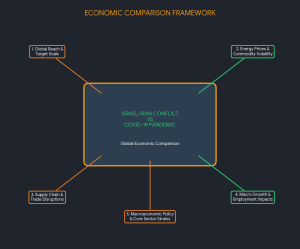
COVID-19 vs the Israel–Iran War: Side by Side
The two crises are different in kind. COVID-19 limited economic activity through lockdowns, health precautions, and labor shortages. The war works through geopolitics, energy markets, shipping routes, and investor nerves. The pandemic touched nearly every sector at once, while the war’s effects are sharpest in energy, transport and trade, and then spread outward through prices.
| Factor | COVID-19 Pandemic | Israel–Iran War |
| Cause | Global health emergency and lockdowns | Military conflict and disruption of the Strait of Hormuz |
| Global reach | Almost every economy at once | Global through energy and prices; hardest for the Gulf and energy importers |
| Employment | Severe job and income losses worldwide | Heaviest in war-affected countries; indirect elsewhere through higher costs |
| Trade | Sharp fall in world trade in 2020 | Severe in energy and shipping; higher fertilizer and freight costs |
| Supply chains | Widespread factory, port and transport disruption | Concentrated in energy, shipping and fertilizer |
| Energy prices | Collapsed as demand dried up | Sharply higher, with Brent above $100 for much of the period |
| Effect on world growth | Global output fell by roughly 3% in 2020 | World Bank cut 2026 global growth to 2.5%, the lowest since the pandemic (the IMF projects 3.0%) |
| Status | Emergency is over; costs are still being counted | Ongoing, with an uncertain outcome |
Which Crisis Hit the Global Economy Harder?
On the evidence so far, COVID-19 was the larger shock. It caused a global contraction, shut down whole sectors at once and forced governments into emergency spending on a scale rarely seen in peacetime. By contrast, the world economy is still growing in 2026, even if slowly: the World Bank forecasts 2.5% and the IMF 3.0%.
But that is not the same as saying the war has been minor. The World Bank cut its forecasts for two-thirds of countries because of it, and it warns that growth could fall to 1.3% if energy disruptions worsen and financial stress builds. The IMF’s more optimistic figure partly reflects a strong technology cycle offsetting the war’s drag, so the outcome varies a lot by country.
There is one more difference that is easy to miss. COVID-19 is now a finished chapter with a final bill. The war is not. Its economic cost depends on whether the Strait of Hormuz reopens, whether the ceasefire holds, and how long oil stays above $100. If the disruption drags on, the gap between the two crises could narrow.
Economic Analysis of the Two Crises
The COVID-19 pandemic and the Iran–Israel war hurt economies through different channels, but both put real pressure on households, businesses, governments and national budgets. This section looks at each crisis on its own terms, using Pakistan as a practical example, and then at what they have in common.
How COVID-19 Damaged Economies
During the pandemic, lockdowns, movement restrictions, broken supply chains, and weak consumer spending slowed growth and pushed prices up in many countries. Pakistan was among the countries that chose targeted “smart” lockdowns instead of keeping the whole country shut for long stretches. The World Bank has noted that these micro-lockdowns, together with cash transfers and support for businesses, helped activity recover after the contraction recorded in fiscal year 2020.
The pandemic also showed how quickly a health crisis can become an economic one. Manufacturing, tourism, transport, retail and small businesses all faced severe disruption, while governments had to spend more on healthcare, social protection and emergency support. Pakistan’s economy contracted in FY2020 and then recovered as restrictions eased. Inflation stayed a concern throughout, mainly because rising food prices weighed most heavily on lower-income families
How the Israel–Iran War Damages Economies
The war has followed a different path. Damage to infrastructure and energy facilities, interrupted production, uncertainty over regional trade, and pressure on oil markets have created risks well beyond the countries’ fighting. The situation became far more serious once shipping through the Strait of Hormuz was severely disrupted. Recent Reuters-compiled shipping data show traffic through the strait still far below normal, with only around ten commodity vessels crossing on a single day in late September. That underlines how much global energy and commodity trade depend on this route.
Because energy markets and international shipping are so closely linked, the shock has spread well beyond the region. Higher oil prices raise transport and production costs, inflate import bills for energy-dependent countries, and push up consumer prices. Brent crude has traded above $100 a barrel for much of the past few months, including about $103 in late September, as the conflict and the negotiations remain unresolved.
Pakistan: A Country Affected Without Fighting
Pakistan shows how a regional war can hurt an economy that is not part of the fighting. Higher international energy prices raise the local cost of petrol and diesel, and that puts pressure on transport, electricity, production, and household budgets. Economists call the next step a second-round effect: once energy gets more expensive, the higher cost gradually shows up in the prices of many other goods and services.
Comparing the Two Crises
The comparison points to one clear difference. COVID-19 restricted economic activity mainly through health measures, lockdowns, labor disruption, and reduced mobility. The Iran–Israel war passes its effects on through destruction, energy markets, shipping routes, geopolitical uncertainty and military spending. In both cases, though, ordinary households end up paying: their purchasing power weakens, living costs rise, jobs become less secure, and the future feels less certain.
The Broader Lesson
Economic stability can be shaken by events that start far outside the economy. A pandemic interrupts production by restricting how people move. A conflict creates similar pressure by disrupting energy supplies, trade routes, infrastructure and investor confidence. The continuing disruption around the Strait of Hormuz is a clear example of how a regional conflict can grow into a global economic concern when a strategically vital shipping route is affected.
Conclusion
COVID-19 remains the biggest economic shock of this century so far. It was global, immediate, and deep, and its effects are still visible in debt levels, supply chains, and the way we work. The Israel–Iran war is smaller in overall scale, but it is far from minor. It has disrupted the world’s most important oil route, pushed prices above $100, and dragged global growth to its weakest level since the pandemic.
The bigger lesson is that economies can be shaken from outside the economy: by a virus one year, by a naval blockade the next. Readers who want to stay ahead of the next shock should watch three things: oil prices, shipping through key chokepoints, and how their own country pays for its energy.
References

As an economics writer at Tech and Tips Economy, Siraj Ullah focuses on demystifying economic policies and financial data. His primary goal is to ensure that general economic topics are clear and easy to understand for the everyday reader. By adjusting the depth and length of his articles based on topic complexity, Siraj works tirelessly to bring approachable economic insights directly to his audience.
GOOD