
Table of Contents
Why a Price Rise Helps One Seller and Ruins Another
Every time a shopkeeper changes a price tag, he is running a small experiment. Will customers keep buying, buy less or walk to the shop next door? Economists call the answer price elasticity, and it is one of the most practical ideas in the subject. It explains why a price rise can increase a firm’s income in one market and wreck it in another.
This guide covers the idea from both sides: how customers respond to prices, and how businesses use that knowledge to set them. You will see the formula, three worked calculations you can check yourself, the five types of elasticity, and a real case from Pakistan’s fuel market. The prices in the worked examples are invented for practice, while the fuel figures come from industry data.

What Price Elasticity of Demand Measures
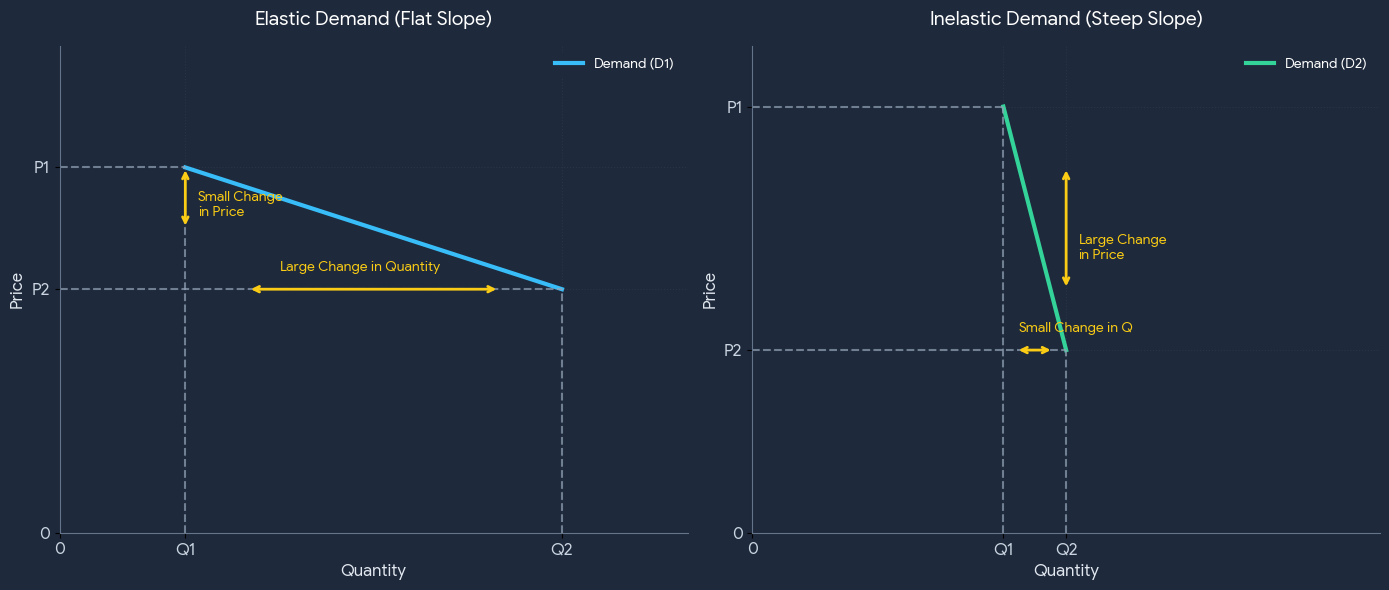
Price elasticity of demand tells you how responsive the quantity people buy is to a change in price. If a small price rise causes a large fall in purchases, demand is elastic. If even a large price rise causes only a small fall, demand is inelastic. A business that knows which case it faces can predict whether a price change will raise or lower its total revenue.
Price elasticity of demand = % change in quantity demanded ÷ % change in price
Each percentage change is the difference between the new and original value, divided by the original value and multiplied by 100. Because demand normally falls when price rises, the result is usually negative, and economists tend to ignore the minus sign and look at the size. A value above 1 means demand is elastic, below 1 means inelastic, and exactly 1 means unitary elasticity.
Three Calculations You Can Check Yourself
Biscuits. A shop raises the price of a packet from Rs100 to Rs110, and weekly sales fall from 1,000 packets to 700.
Change in price = (110 − 100) ÷ 100 × 100 = +10%
Change in quantity = (700 − 1,000) ÷ 1,000 × 100 = −30%
Elasticity = −30% ÷ 10% = −3.0
The size is 3, well above 1, so demand is elastic. Revenue falls from Rs100,000 (100 × 1,000) to Rs77,000 (110 × 700), which means the price rise was a mistake.
Cooking oil. The price rises from Rs500 to Rs550 per litre, and weekly purchases fall from 1,000 litres to 920.
Change in price = (550 − 500) ÷ 500 × 100 = +10%
Change in quantity = (920 − 1,000) ÷ 1,000 × 100 = −8%
Elasticity = −8% ÷ 10% = −0.8
The size is 0.8, below 1, so demand is inelastic. Revenue rises from Rs500,000 to Rs506,000. These numbers are invented, but the pattern is what economists expect for a household essential.
A bigger change, using the midpoint method. For larger changes, the midpoint method gives the same answer whether the price rises or falls, because it divides by the average of the old and new values. Say the price goes from Rs100 to Rs120 and quantity falls from 500 to 400. The change in quantity is −100 ÷ 450 = −22.2%, and the change in price is 20 ÷ 110 = 18.2%. Elasticity is 22.2 ÷ 18.2 = 1.22, so demand is elastic.
The Five Types of Elasticity
Elasticity is not the same for every product, and it helps to sort demand into five types.
| Type | Elasticity value | When price rises | Effect on total revenue | Example |
|---|---|---|---|---|
| Elastic | Greater than 1 | Quantity falls by a larger percentage | Revenue falls | Soft drinks, branded clothing |
| Inelastic | Between 0 and 1 | Quantity falls by a smaller percentage | Revenue rises | Medicines, electricity, petrol |
| Unitary elastic | Equal to 1 | Quantity falls by the same percentage | Revenue stays the same | A theoretical middle case |
| Perfectly elastic | Infinite | Quantity falls to zero | Revenue falls to zero | A single wheat farmer charging above the market price |
| Perfectly inelastic | Zero | Quantity does not change | Revenue rises fully with price | A life-saving drug with no substitute (theoretical) |
Elastic demand appears where buyers have good substitutes and can easily switch or wait. Soft drinks and branded clothes fit here, and sellers in such markets usually do better with promotions and competitive prices than with price rises.
Inelastic demand appears with essentials that have few substitutes, such as medicines, electricity and fuel. People need roughly the same amount whatever the price, so a seller can often raise prices and increase revenue. That is also why governments watch these markets closely and sometimes regulate them.
Unitary elasticity is the dividing line between the two. A 10 per cent price rise leads to a 10 per cent fall in quantity, so revenue stays about the same.
The two extremes are mostly theoretical. With perfectly elastic demand, buyers purchase only at one price, which is the position of a single wheat farmer in a crowded market who cannot charge more than the going rate. With perfectly inelastic demand, buyers purchase the same quantity at any price. Nobody ignores prices entirely, though a vital medicine with no substitute comes close.
Why Some Goods Respond More Than Others
How strongly buyers react depends on the product and on the buyer’s situation. Six things matter most:
- Substitutes: the more alternatives there are, the more elastic demand becomes.
- Necessity or luxury: necessities tend to be inelastic, luxuries elastic.
- Share of the budget: a car purchase gets far more scrutiny than a packet of salt.
- Income level: price matters more to low-income buyers, so they usually respond more strongly.
- Brand loyalty: loyal customers are less sensitive to price.
- Time: demand is usually more elastic over a longer period, because buyers have time to find alternatives.
Turning the Number Into a Pricing Decision
Once a firm knows which side of 1 its elasticity falls on, the revenue effect of a price change is predictable.
| If demand is… | Raising the price… | Cutting the price… | Sensible approach |
|---|---|---|---|
| Elastic (above 1) | Lowers total revenue | Raises total revenue | Keep prices competitive, use promotions and aim for volume |
| Inelastic (below 1) | Raises total revenue | Lowers total revenue | A higher price can work, but watch for public or regulatory reaction |
| Unitary (equal to 1) | Leaves revenue unchanged | Leaves revenue unchanged | Compete on cost and quality instead |
When Pakistan Pulled Back Its Fuel Subsidies
Fuel gave Pakistan an unplanned test of this theory. In May 2022 the government withdrew fuel subsidies worth about Rs100 billion a month, and pump prices climbed sharply. Industry data reported by Business Recorder show what happened over the 2022-23 fiscal year compared with the one before:
| Fuel | Average price, FY22 | Average price, FY23 | Price change | Sales change | Rough elasticity |
|---|---|---|---|---|---|
| Petrol | Rs148 per litre | Rs245 per litre | +66% | −17% | About 0.3 |
| Diesel | Rs145 per litre | Rs255 per litre | +76% | −28% | About 0.4 |
Both ratios are well below 1, which fits the textbook claim that fuel is inelastic: buyers cut back, but by a much smaller share than the price rise. Even so, sales did fall, and overall petroleum sales dropped 27 per cent to about 16.6 million tonnes, the lowest level in years. That shows why inelastic does not mean unresponsive. People drove less, shared rides and put off trips even though they could not stop buying.
This is a rough picture, not a clean experiment. The same year brought record floods, a sharp economic slowdown and a flow of cheaper smuggled fuel from across the Iranian border, all of which pushed sales down independently of price. Use the ratios as a guide to the size of the response, not as exact measurements. The sharper drop in diesel also reflects its link to industry and transport, which slowed during the downturn.
Where You Can Spot Elasticity in Everyday Markets
- Wheat flour and cooking oil. Almost every household needs them, so families cut back a little, perhaps by buying smaller quantities or cheaper grades, but cannot stop. That is why a rise in the price of flour hurts low-income households and quickly becomes a political issue.
- Branded and unbranded goods. A branded biscuit or soft drink has many substitutes, so a small price rise can send customers to a rival or an unbranded product.
- Smartphones. Demand for high-end models is less elastic because of brand loyalty and status, while budget and mid-range buyers compare features and prices across many brands.
- Airlines. Business travellers who must attend a meeting are less price-sensitive than holiday travellers who can change dates or destinations, which is why airlines charge different fares to different customers.
- Ride-hailing. Fares jump at rush hour or in the rain. Commuters who must reach work on time pay the higher fare, while people who can wait or take a bus respond to the price.
The common thread is that elasticity depends on the buyer’s alternatives and urgency, not on the product alone. A policymaker who raises the price of an essential good expecting a sharp cut in consumption is likely to be disappointed, and a firm that raises the price of a good with many substitutes is likely to lose customers.
How Firms Use Elasticity When Setting Prices
A sound price must be low enough that customers buy and high enough that the firm earns a profit. There is no single best method, and five frameworks are common. Each one makes more sense once you think about elasticity.
- Penetration pricing: launching at a low price to win customers quickly, such as a streaming service offering the first three months at half price. It suits markets where buyers are price-sensitive.
- Premium pricing: setting a high price to signal quality or exclusivity, as luxury fashion labels and top-end smartphones do. It works where loyal buyers make demand relatively inelastic.
- Competitive pricing: matching what rivals charge, as petrol stations on the same road or grocers in the same neighbourhood do. It avoids price wars when substitutes are close.
- Cost-plus pricing: adding a fixed margin to cost, like a tailor who adds 30 per cent to the cost of cloth and labour. It is simple and covers costs, but ignores how customers actually react.
- Dynamic pricing: changing prices with demand, season or time of day, as airlines, hotels and ride-hailing apps do. It works because some customers are far less price-sensitive than others.
Before changing a price, firms try to predict the reaction in four ways. They study sales records from earlier price changes, which is the most direct evidence of elasticity. They watch household incomes and inflation, because squeezed budgets make customers more price-sensitive. They test small price changes or survey customers before going nationwide. And they follow competitors, since a rival’s price cut or a new substitute makes demand more elastic.
None of this is easy. Customer behaviour shifts with fashion, income and expectations, competitors may respond and inflation or a falling currency changes how much households can spend. That is why firms combine research and past data with small-scale tests before committing. To understand the foundations behind this, read our guide on demand and supply.
Marshall, and the Bigger Picture
The concept comes from Alfred Marshall, who introduced the elasticity of demand in his Principles of Economics (1890). He showed how the quantity demanded responds to a price change, which turned a loose idea into something economists could measure.
In my view, elasticity also offers a useful way to think about the strength of an economy. Households and firms that can adjust quickly to new prices by switching products, suppliers or methods absorb shocks more easily than those that cannot. This is my own interpretation, offered as a way of thinking and not as an established theory.
The Takeaway
A pricing strategy sets the starting price, and elasticity tells you how customers will react to it. Where demand is elastic, even a small rise can cut sales sharply, so a high-volume, low-price approach usually pays better. Where demand is inelastic, as with essentials or loyal brands, a firm can charge more without losing many customers, though fairness and regulators still matter. Elasticity is a number you can calculate from real sales data, which turns pricing from a gamble into a decision backed by evidence.
Frequently Asked Questions
What is price elasticity of demand in simple words?
It measures how much the quantity people buy changes when the price changes. A big change means demand is elastic, and a small change means it is inelastic.
How do I know if demand is elastic or inelastic?
Divide the percentage change in quantity by the percentage change in price. If the result, ignoring the minus sign, is greater than 1, demand is elastic. If it is less than 1, demand is inelastic.
Why is the elasticity of petrol demand low?
Most people need to travel and have no quick substitute, so they keep buying close to the same amount when prices rise, especially in the short run. Over a longer period they can switch to efficient vehicles or public transport.
Does a price rise always increase revenue?
No. Revenue rises only when demand is inelastic. When demand is elastic, the fall in quantity outweighs the price rise, so revenue falls.
What affects how elastic a product is?
The main factors are the number of substitutes, whether the product is a necessity or a luxury, its share of the budget, the time buyers have to adjust and brand loyalty.
Editorial Note
This article was written by Siraj Buzdar for Tech and Tips Economy as a general educational guide to price elasticity of demand and pricing strategy. The definitions and formulas follow standard microeconomics textbooks and the references below, explained in our own words. The prices, quantities and revenue figures in the worked calculations are invented to show how the method works and do not describe any real product or company. The fuel prices and sales changes for FY2023 are industry figures reported by Business Recorder, rounded, and the elasticity ratios are the author’s own rough calculations from them.
The comments about Alfred Marshall are based on his published work, and the paragraph that begins “In my view” is the author’s own interpretation. This content is for general education only and is not business, financial or investment advice. This article was last reviewed in November 2026. If you notice an error, please tell us through our contact page.
References
- Price Elasticity of Demand: Meaning, Types, and Factors That Impact It
- The Price Elasticity of Demand and Celebrity Brands
- A Refresher on Price Elasticity
- Business Recorder: Petroleum product sales decline 27% in FY23

Siraj Buzdar is an Economics writer and founder of Tech and Tips Economy. He has a BS (Hons) degree from COMSATS University, Abbottabad and has more than 5 years of practical experience in the banking sector, where he had worked in Financial Operations, Liquidity Analysis and Clearing Systems. His passion for macroeconomics, fiscal policy and Islamic finance has led him to study and research the connection between academic economic theories and the economic realities, which helps students, professionals and readers in general to understand complex economic developments in a clear and accurate manner.