
Table of Contents
Economic Concept: The Production Possibility Frontier (PPF)
Fundamentally, the PPF serves as a visual tool showcasing the highest possible combinations of two goods or services. This model assumes that an economy is using all its resources and technology to the fullest. By delineating these limits, the PPF underscores the decisions and trade-offs nations face when distributing their limited resources.
Effective Strategies for Enhancing Resource Output:
– Embracing Precision Technology and Automation
– Implementing Lean Supply Chains and Reducing Waste
– Focusing on Strategic Skills Development and Enhancing Human Capital
– Promoting Circular Resource Management and Sustainable Practices
– Leveraging Data-Driven Approaches for Demand Prediction and Planning
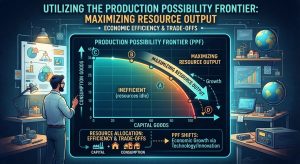
What is Production Possibility Frontier (PPF)?
One way to visually grasp important concepts within economics is through the use of a Production Possibility Frontier (PPF) graph. This graphical tool aids in comprehending various economic principles such as the scarcity of resources, the trade-offs between different goods, opportunity costs, as well as the efficiency of production.
For instance, consider a scenario where a nation focuses on producing cars and wheat exclusively. By examining the PPF, one can determine the maximum number of cars that could be manufactured by decreasing wheat production, and conversely, the potential impact on wheat output if car production is prioritized. This visualization allows for a clear illustration of the trade-offs involved in resource allocation and production decisions.
Let’s delve into an illustrative example of a PPF complete with relevant data to further enhance our understanding of this economic concept.
| Production Combination | Wheat (tons) | Cars (units) |
|---|---|---|
| A (All wheat) | 1000 | 0 |
| B | 800 | 20 |
| C | 600 | 40 |
| D | 400 | 60 |
In a scenario where an economy possesses constrained resources, it can only manufacture two commodities: Wheat and Cars.
Production Allocation
As per the data presented in the table, an increase in car production necessitates a reduction in wheat output. This reduction represents the concept of opportunity cost.
PPF Curve Representation


Exploring the Significance of the Production Possibility Frontier
Delving into the essential concept of the Production Possibility Frontier (PPF) goes beyond its basic portrayal as a concave curve in economics. It embodies a dynamic representation influenced by various factors, including changing variables, resource allocation efficiencies, and real-world economic dynamics. To gain a profound understanding of this model, we must deconstruct it into three fundamental aspects: the governing principle shaping its curvature, the pivotal points evaluating a nation’s present performance, and the external stimuli propelling the continuous evolution of this frontier. These interconnected elements elucidate how economies harmonize their existing capacities with future growth prospects.
The Law of Increasing Opportunity Cost
Exploring the Significance of Curve Points
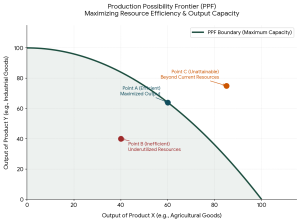
When depicted on a chart, the Production Possibility Frontier (PPF) serves a purpose beyond being a mere boundary; it functions as a tool for evaluating a country’s economic well-being. Each point plotted on, near, or inside this boundary conveys a unique narrative about how well a society is utilizing its resources. Interpreting these positions enables us to assess whether an economy is prospering, facing challenges, or aiming for unattainable targets.
Interpretation of the Points:
– Points on the boundary: Indicate optimal productive efficiency.
– Points within the boundary: Suggest inefficiency or high unemployment.
– Points outside the boundary: Represent currently unachievable objectives.
The Key Constraint:
Points beyond the boundary necessitate additional resources or improved technology.
Factors Influencing Economic Boundaries
– Expansion Outwards:
New discoveries and technological advancements propel boundaries to expand.
– Contraction Inwards:
Conflicts, natural calamities, or depletion of resources diminish the economic capacity.
– Uneven Adjustments:
Technological upgrades in specific sectors alter only one dimension.
– Economic Advancement:
Sustained outward shifts indicate enduring national progress.
The Role of the Production Possibility Frontier (PPF) in an Economy:
Crucial for understanding resource allocation, economic growth measurement, policy making, and trade and specialization. Economists and governments utilize the PPF to efficiently distribute resources among various sectors such as agriculture, industry, and services. Economic growth, reflected by an outward shift in the PPF, is influenced by factors like technological advancements, increased capital stock, and enhanced labor productivity through education. Governments employ PPF analysis to make decisions regarding defense, healthcare, agriculture, industrial development, consumption, and investment. Moreover, the PPF concept elucidates international trade dynamics, emphasizing countries’ specialization in goods where they possess a comparative advantage to boost overall output.
For example
In Pakistan’s economy, investing resources in textile production may impact agriculture machinery output, while enhancing education and skills can elevate labor productivity and expand the PPF. The PPF model, with outward and inward shifts, serves as a practical tool for decision-making processes, aiding in identifying efficient production levels, supporting budget planning, guiding industrial policies, and elucidating trade-offs in national development strategies.
Final Idea
The concept of the Production Possibility Frontier is a cornerstone in economics, shedding light on the challenge of scarcity and the crucial role of decision-making. It illustrates the delicate equilibrium an economy must strike among various commodities and services within the constraints of finite resources.
Grasping the PPF empowers policymakers to enhance resource distribution, devise effective strategies for economic advancement, and foster national progress. Moreover, it enlightens individuals on the unavoidable trade-offs in economic decision-making – opting for one avenue typically involves forgoing another in the realm of practical economics.
In essence, the PPF serves as a potent instrument that bridges economic theory with tangible economic planning and advancement.
References

As an economics writer at Tech and Tips Economy, Siraj Ullah focuses on demystifying economic policies and financial data. His primary goal is to ensure that general economic topics are clear and easy to understand for the everyday reader. By adjusting the depth and length of his articles based on topic complexity, Siraj works tirelessly to bring approachable economic insights directly to his audience.