
Table of Contents
The Influence of the US-Iran-Israel Conflict on the Global Economy through Petro Economics:
With fossil fuels still powering over 80% of the planet’s energy consumption, particularly oil meeting substantial demands in transportation and industrial sectors, oil emerges as one of the most politically charged commodities in the global financial landscape.
Should you seek more in-depth insights into this subject matter, feel welcome to explore further details:
In the realm of Petro Economics:
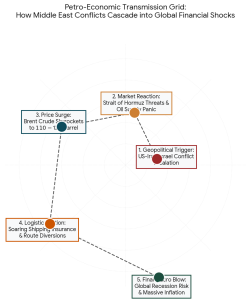
With some of the planet’s most substantial confirmed oil reservoirs, the Middle East stands as a pivotal cornerstone in global petro economics. The Strait of Hormuz plays a vital role in this energy framework, serving as a crucial juncture where almost 20% of the world’s oil trade transits every day. Linking the Persian Gulf to the Arabian Sea, this narrow strait acts as a critical bottleneck in the worldwide energy provision, where any abrupt interruption in trade instantaneously impacts the international oil market prices.
Impactful Consequences of the US–Iran–Israel Conflict:
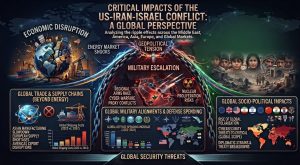
The escalating geopolitical tensions in the Middle East are directly impacting crucial international energy hubs and reshaping the flow of resources. These geopolitical upheavals are generating significant instability in global stock markets, compelling developing countries to grapple with substantial macroeconomic disparities.
Key Points:
A.Unprecedented Surges in Global Prices of Crude Oil and Natural Gas
B.Elevated Costs of Maritime Insurance and Sea Freight Logistics
C.Noteworthy Shifts Toward Safe-Haven Assets Such as Gold by Major Institutions
D.Increased Government Budget Deficits Stemming from Heightened Military Security Spending
E.Swift Depreciation of Emerging Market Currencies and Escalation of Domestic Inflation Rates
For Instance:
The Strait of Hormuz witnesses the transit of approximately 17 to 20 million barrels of oil daily.
Even a minor disruption in this passage could trigger a rapid 10% to 25% surge in oil prices in a matter of days.
The US–Iran–Israel Conflict: Recent Escalation
The mounting tensions and military clashes involving the United States, Iran, and Israel have significantly amplified global uncertainties. This conflict encompasses:
1.Direct and indirect military offensives in the region
2.Growing naval tensions in the Persian Gulf
3.Cyber and proxy warfare impacting energy infrastructures
4.Heightened insecurity along crucial shipping lanes
Consequently, the global oil markets have acquired heightened sensitivity to any political developments unfolding in the region.
Immediate Impact on Oil Prices
| Risk Level | Estimated Oil Price (per Barrel) | Potential Global Economic Impact |
|---|---|---|
| Baseline Price | $80 – $85 | Standard inflation and normal trade routes |
| Peak Tension | $95 – $100 | Rising shipping insurance and freight costs |
| Extreme Risk | $110 – $120 | High risk of global recession and food inflation |
Rising Oil Prices Have A Direct Impact On the Costs of Food Production
Rising oil prices Affecting various sectors of the economy. For industrial production, higher oil prices translate into increased operational expenses for manufacturing industries. This, in turn, leads to a reduction in profit margins and a slowdown in output levels. Global economic forecasts indicate that a mere 10% surge in oil prices can result in inflation spikes ranging from 0.3% to 0.5% in major economic hubs like the United States and Europe.
Developing nations
Developing nations, such as Pakistan, India, Bangladesh, and various African countries, are particularly susceptible to oil price fluctuations due to their heavy reliance on oil imports, fragile currency exchange rates, and limited foreign reserves. A modest $10 increase per barrel can substantially elevate import bills for these oil-dependent economies, triggering currency devaluation and heightened domestic inflation rates. Consequently, governments may find themselves compelled to boost fuel subsidies, exacerbating fiscal deficits. In Pakistan, for instance, energy imports constitute a significant portion of total import expenditure, rendering the economy highly vulnerable to global oil price volatilities.
Geopolitical Instabilities
The financial markets and investor sentiment are also significantly impacted by geopolitical instabilities in oil-rich regions, prompting investors to flock towards safer assets like gold and the US dollar while causing downturns in emerging market stock indices. This phenomenon contributes to heightened volatility in energy stocks and airline sectors.
Supply Chain Disruptions
Supply chain disruptions further compound the economic repercussions of escalating oil prices. The ongoing geopolitical tensions in regions abundant in oil reserves, such as the US–Iran–Israel conflict, have raised uncertainties for shipping companies navigating through the Persian Gulf. This has led to increased shipping insurance premiums, route diversions prolonging travel durations and expenses, and delays in the transportation of raw materials and finished products. As a result, freight costs have surged by 15% to 30% during periods of heightened tensions, sending shockwaves across global industries, spanning from electronics to food supply chains.
In the long term, sustained or aggravated geopolitical disputes could yield various enduring consequences.
Sustained High Oil Prices
Potential Global Economic Downturn
The convergence of elevated energy costs and a deceleration in economic expansion may propel leading economies into a scenario reminiscent of a recession. Throughout history, oil price surges have often precipitated worldwide economic contractions, mirroring the events of the 1970s.
Hastening the Shift Towards Sustainable Energy
A promising aftermath is the burgeoning worldwide transition towards sustainable energy outlets like solar, wind, and nuclear power. Nations are striving to diminish their reliance on politically precarious oil-rich regions.
Transformation of Global Energy Diplomacy
Nations that thrive on energy exports could augment their geopolitical sway, compelling import-reliant countries to diversify their energy supply chains.
Insights from the Study of Petro Economics
In the context of the ongoing crisis, it becomes evident that oil transcends its status as a mere commodity; it emerges as a geopolitical tool that wields significant influence over matters of war, peace, inflation, and worldwide stability. Throughout history, any significant conflict in regions rich in oil resources has consistently resulted in:
– Fluctuations in prices
– Surges in inflation rates
– Heightened economic ambiguity on a global scale. Consequently, petro economics stands out as a crucial domain for grasping the intricacies of contemporary global finance.
Implications and Observations on the Subject
The conflict involving the United States, Iran, and Israel underscores the intricate interconnectivity of global economies and energy markets. Even regional geopolitical conflicts have the potential to disrupt oil supply chains, triggering far-reaching economic repercussions.
From inflationary pressures to disruptions in supply chains and fluctuations in financial markets, the influence of petro-economics is both immediate and enduring.
In an era marked by heightened geopolitical instability, nations heavily reliant on oil imports are particularly vulnerable to risks. Simultaneously, the crisis is hastening international dialogues on energy diversification and sustainable alternatives.
Ultimately, the resilience of global economic stability in the coming years will hinge on nations’ ability to prudently navigate their reliance on oil and transition towards more robust energy frameworks.
References

As an economics writer at Tech and Tips Economy, Siraj Ullah focuses on demystifying economic policies and financial data. His primary goal is to ensure that general economic topics are clear and easy to understand for the everyday reader. By adjusting the depth and length of his articles based on topic complexity, Siraj works tirelessly to bring approachable economic insights directly to his audience.