
Table of Contents
The Role Of Government Budget In Economic Growth and the National Economy:
One of the key instruments in the arsenal of any government for managing the economy is the state budget. It serves as a comprehensive financial roadmap, outlining anticipated tax revenues and planned expenditures in crucial areas such as education, healthcare, infrastructure, and defense. The strategic blueprint crafted by policymakers significantly impacts the stability and growth trajectory of the national economy. A meticulously designed budget can enhance production capabilities and spur investments in infrastructure, whereas mismanaged public expenditure has the potential to trigger inflation, stifle market expansion, and destabilize the overall economic landscape.
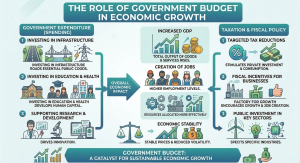
Ways in Which Government Budgets Impact Wealth Generation:
The allocation of public funds plays a crucial role in determining the distribution of resources within a nation. By examining these budgetary strategies, one can discern how government expenditure contributes to the development of a robust national infrastructure. Key aspects include directing funds towards expanding the modern industrial sector, incentivizing private market investments through tax adjustments, enhancing social safety nets to reduce wealth inequality, fostering employment growth via large-scale public infrastructure initiatives, and maintaining sustainable price levels by managing national debt effectively.
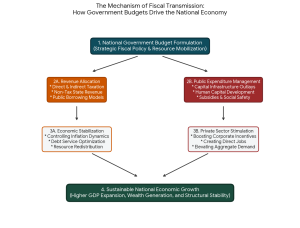
Budget as a Driver of Economic Growth:
Development Spending:
Investments strategically planned to enhance future capabilities, including the construction of dams, expansion of public healthcare systems, development of modern schools, and establishment of energy networks.
Non-Development (Operational) Spending:
In order to sustain a state, constant fund allocation is necessary for various expenditures like public sector salaries, pension funds for retirees, administrative costs, defense budgets, and debt interest payments.
Studies demonstrate that countries that invest more in capital infrastructure rather than day-to-day expenses witness accelerated economic growth. Emerging economies typically allocate around 3% to 7% of their GDP for building assets, while developed nations emphasize funding technology and research initiatives. Consequently, if a government exhausts its resources on immediate operational costs instead of investing in lasting assets, the nation’s economic advancement may stagnate.
Allocation Breakdown: Development vs. Operational Spending
| Expenditure Type | Primary Focus | Core Examples | Long-Term Economic Impact |
|---|---|---|---|
| Development Spending | Building Capacity for Future Assets |
Infrastructure such as roads, power grids, dams, public schools, and healthcare systems. |
Generating employment opportunities, initiating the multiplier effect, and enhancing the GDP, the growth acceleration is apparent. |
| Non-Development Spending | Government Operations in Daily Activities |
Salaries of government employees, retirement benefits, national security expenses, and debt interest disbursements. |
Sustaining Stability: Crucial for governing a nation, yet excessive expenditures hinder advancement. |
Role of Tax Revenue in Growth
Government revenue heavily relies on tax collection, serving as its primary source of income. An efficient tax system plays a pivotal role in enabling governments to finance public services and infrastructure projects without resorting to extensive borrowing. International statistics reveal that advanced economies typically generate tax revenues ranging from 25% to 40% of their GDP, whereas emerging economies often fall short, collecting a mere 15% to 18% of GDP. Insufficient tax collection triggers budget shortfalls, compelling governments to seek loans, subsequently leading to inflation, elevated interest rates, and hindered economic growth. A harmonious tax framework promotes equity by ensuring that both individuals and businesses contribute their share towards national progress.
Impact of Budget Deficit
In cases where government expenditures exceed revenue, a budget deficit arises. Although moderate deficits can bolster growth in times of economic decline, continual deficits pose significant challenges.
Numerous emerging nations encounter deficits averaging between 5% and 7% of their GDP each year. This frequently results in:
1- Escalating public debt
2- Depreciation of the currency
3- Pressures of inflation
4- Diminished trust from investors
For instance, a nation resorting to continuous borrowing to fund its obligations instead of enhancing productive investments might enjoy immediate respite but could face prolonged economic instability down the road.
Infrastructure Investment and Growth
Enhancing infrastructure stands out as a pivotal result of effective budgeting. Improvements in roads, railways, energy networks, and digital systems profoundly enhance efficiency in various industries.
Illustratively:
1- Enhanced roads cut down transportation expenses for farmers and enterprises.
2- Stable electricity levels up industrial output.
3- Robust digital infrastructure bolsters IT and service sectors.
Research conducted by renowned financial bodies highlights that nations prioritizing infrastructure development witness a 1% to 2% annual surge in GDP growth compared to those with inadequate investments in this realm.
Social Sector Spending
Enhancing economic prosperity involves more than just bolstering physical infrastructure; it necessitates fostering human development. Investments in education, healthcare, and skills training not only enhance workforce productivity but also pave the way for sustainable growth.
1- Improved health standards lead to reduced healthcare expenditures and heightened labor efficiency.
2- Enhanced educational opportunities result in a more skilled workforce and increased innovation.
3- Nations allocating more than 4% of GDP to education and 3% to healthcare typically exhibit robust long-term economic resilience.
Practical Illustration in the Context of Emerging Markets
Government budgets in numerous developing nations, particularly in South Asia, frequently face limitations due to debt obligations and insufficient tax income. A considerable portion of the budget is allocated to servicing debts, thereby restricting resources available for developmental purposes. This situation is exemplified by instances where as much as 20% to 30% of the total expenditure in certain fiscal periods is channeled towards debt repayment, consequently constraining investments in sectors that drive economic expansion. Nonetheless, by enhancing tax collection efficiency and curbing frivolous expenditures, governments have the opportunity to reallocate funds towards enhancing infrastructure and educational systems. This strategic reallocation can lead to substantial long-term improvements in GDP growth rates.
Budget Planning and Economic Stability
Maintaining economic stability through effective budget planning involves managing inflation, preserving currency value, and fostering investment incentives.
Foreign investors often look at:
When it comes to attracting foreign investors, key factors that capture their interest include the levels of fiscal deficit, tax policies, and government spending priorities. Maintaining a stable and transparent budget is crucial as it enhances investor confidence, thereby attracting foreign direct investment (FDI). Notably, a mere 1% rise in FDI influx can yield substantial benefits by fueling industrial expansion and job creation.
Summary
A national economy blueprint, known as the state budget, plays a crucial role in economic strategizing, shaping the way resources are amassed and allocated. Prudent utilization of this framework has the potential to revamp infrastructure, enhance human capabilities, alleviate poverty, and boost economic advancement. Conversely, mishandling it may pave the way for debt dilemmas, inflation, and hindered progress. Hence, ensuring efficient budgetary planning, robust tax structures, and prudent expenditure is imperative for fostering enduring economic progress worldwide.
References
Government Spending: Efficiency, Waste, and Economic Growth
Macro Economy The Government Budget and the Economy

As an economics writer at Tech and Tips Economy, Siraj Ullah focuses on demystifying economic policies and financial data. His primary goal is to ensure that general economic topics are clear and easy to understand for the everyday reader. By adjusting the depth and length of his articles based on topic complexity, Siraj works tirelessly to bring approachable economic insights directly to his audience.
what about this article
good