
Introduction of Correlation between Poverty and Inflation
Economic progress is a fundamental objective for all nations. Governments worldwide work towards enhancing living standards, fostering job opportunities and boosting national revenue. Nonetheless, the journey towards sustainable growth faces two significant economic hurdles: poverty and inflation. While these challenges are commonly intertwined in discussions, they signify distinct economic circumstances that are intricately linked.
The inquiry often arises whether poverty breeds inflation or if inflation breeds poverty. The reality lies in the fact that both factors can exert influence on each other depending on a nation’s economic landscape, governmental strategies, and developmental stage. Unravelling their interplay holds paramount importance for policymakers, entrepreneurs, scholars, and individuals keen on the field of economics.
What Is Poverty?
Individuals or households experiencing poverty do not possess adequate income or resources to fulfill essential requirements such as food, clean water, housing, healthcare, education, and clothing.

Economists generally classify poverty into two main categories:

1. Absolute Poverty
When individuals are unable to meet the basic requirements for sustaining life, they face absolute poverty. The World Bank employs a global poverty threshold to assess extreme poverty, enabling nations to evaluate living conditions on a global scale.
2. Relative Poverty
Poverty goes beyond merely having a low income, encompassing various repercussions such as compromised health, restricted access to education, unemployment, societal disparities and decreased efficiency. It poses a significant obstacle to sustainable economic progress, hindering individuals from fully engaging in conventional economic and social activities due to their earnings falling well below the societal average, a condition known as relative poverty.
What Is Inflation?
The phenomenon known as inflation refers to the persistent uptrend in the overall price level of goods and services as time progresses. As prices escalate, the value of money diminishes, resulting in consumers being able to buy a reduced quantity of goods with the same income. To illustrate, if a loaf of bread is priced at $2 presently and escalates to $2.20 the following year without any salary hike, your purchasing power diminishes due to inflation. Typically, inflation is gauged through the Consumer Price Index (CPI), which monitors fluctuations in the prices of frequently bought goods and services.
Types of Inflation
| Type | Description |
|---|---|
| Mild Inflation | Sustained and modest price increments are conducive to fostering economic expansion. |
| Demand-Pull Inflation | When supply falls short of demand, this situation arises. |
| Cost-Push Inflation | Increased production costs often lead to higher prices for products. |
| Hyperinflation | Swift and unmanageable increase in prices causing significant harm to an economy. |
In vibrant economies, moderate inflation is typically deemed acceptable. Yet, sustained high inflation diminishes buying ability, deters investments, and breeds economic uncertainty.
Poverty vs. Inflation: Are They the Same?
The simple answer is No.
Poverty and inflation, while closely intertwined, represent distinct economic challenges.
| Poverty | Inflation |
|---|---|
| Scarcity of funds and deprivation of essential necessities is indicated by poverty. | Refers to a rise in the general price level. |
| Emphasizes the quality of life for individuals. | Focuses on changes in prices across the economy. |
| Frequently arises due to lack of employment opportunities and decreased efficiency. | Often results from excessive demand, rising costs, or monetary expansion. |
| Assessed through metrics such as poverty levels and income criteria. | Measured using inflation rates and CPI. |
Consequently, poverty and inflation do not represent identical concepts; however, they frequently intertwine, impacting economic outcomes.
Does Inflation Cause Poverty or Does Poverty Cause Inflation?
The correlation between inflation and poverty is bidirectional, making it challenging to determine whether inflation leads to poverty or poverty leads to inflation.
How Inflation Can Increase Poverty
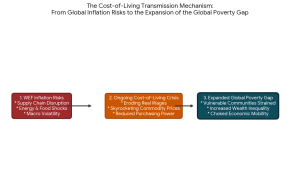
In cases where inflation outpaces wage growth, households experience a decline in their purchasing ability. Necessities like food, fuel, transportation, and healthcare become pricier, impacting low-income families disproportionately due to their higher expenditure on essentials. Consequently:
A- Real incomes diminish.
B- Savings depreciate.
C- Household spending decreases.
D- More individuals slip below the poverty threshold.
For instance, with inflation hitting 15% and a mere 5% salary hike, workers face a substantial erosion in their actual buying power.
Can Poverty Cause Inflation?
Poverty alone is not the primary driver of inflation, but it can play a role indirectly. Nations grappling with pervasive poverty typically face challenges such as reduced productivity, underwhelming industrial performance, minimal investments, and shortages in the supply chain. In situations where production fails to meet demand, scarcities could lead to price hikes.
Nonetheless, economists commonly concur that inflation is predominantly shaped by factors like monetary and fiscal policies, exchange rates, energy costs, and interruptions in the supply chain, rather than solely by poverty.
The Impact of Poverty and Inflation on GDP Growth
The Gross Domestic Product (GDP) is a metric that quantifies the overall worth of goods and services generated within a nation. Poverty and inflation impact GDP uniquely and distinctly.
GDP Is Impacted By Poverty
Through various channels such as decreased labor productivity, lower educational achievements, higher healthcare expenses, restricted entrepreneurial activities, and diminished consumer demand.
GDP Is Impacted by Inflation
On the other hand, inflation can have both positive effects like boosting business investments, aiding employment, and fostering production, as well as negative impacts such as dissuading investments, diminishing consumer trust, escalating production costs, and fostering economic unpredictability. The coexistence of high inflation and extensive poverty typically hampers economic progress, presenting a challenge for nations striving for lasting development.
The Role of Poverty and Inflation in Economic Development
Economic progress should not be solely assessed through a nation’s GDP figures. It encompasses advancements in quality of life, education, healthcare, job opportunities, infrastructure, and fair income distribution. The presence of poverty and inflation greatly influences a country’s trajectory towards prosperity.
Factors
Poverty acts as a barrier to obtaining education, healthcare, and financial resources, leading to decreased workforce efficiency, a scarcity of skilled labor for businesses, and diminished government tax revenues. These factors collectively impede economic growth over time.
Inflation Impacts the Economy
Conversely, inflation impacts the economy by altering price levels. A moderate inflation rate—usually around 2–3% annually in many developed nations—is generally viewed positively as it fosters spending and investment. However, persistent high inflation breeds uncertainty, deters business investments, and erodes consumers’ purchasing power.
Which Is More Harmful: Poverty or Inflation?
There is no universal answer because both create different economic challenges.
| Factor | Poverty | Inflation |
|---|---|---|
| Directly affects living standards | ✔ High | ✔ Moderate |
| Reduces purchasing power | ✔ Yes | ✔ Yes |
| Discourages investment | Indirectly | ✔ Directly |
| Increases inequality | ✔ Yes | ✔ Yes |
| Slows long-term GDP growth | ✔ Strongly | ✔ If inflation is high |
In terms of its long-lasting repercussions, poverty undermines human capital, education, health, and workforce productivity, while steep inflation can trigger significant short-term economic turbulence, particularly when salaries fail to match the surging prices.
The top-performing economies prioritize tackling these issues concurrently instead of addressing them in isolation.
How Countries Reduce Poverty and Control Inflation
Governments use a combination of economic and social policies to address these challenges.
Policies to Reduce Poverty
Consider allocating resources towards enhancing education and vocational training standards. Stimulate job creation by focusing on advancing industrial and infrastructure projects. Foster growth in small and medium-sized businesses. Enhance healthcare services and social welfare initiatives. Boost agricultural output and rural progress.
Policies to Control Inflation
Ensure prudent fiscal measures are upheld by the central banking institution to:
A- Regulate the escalation of money circulation.
B- Enhance local manufacturing to alleviate scarcity issues.
C- Foster market competitiveness.
D- Minimize superfluous governmental financial shortfalls.
E- Stabilize currency exchange values and enhance logistical networks.
By adopting a harmonized strategy, economic stability can be preserved alongside the promotion of comprehensive growth.

Lessons from Different Countries
China
For forty years, China has successfully raised hundreds of millions of individuals out of severe poverty by focusing on industrialization, export-driven expansion, investing in infrastructure, and enhancing educational opportunities. This improved productivity has propelled China into becoming one of the globe’s leading economies.
South Korea
Throughout the 1960s, South Korea was classified as a nation with a low income. However, through significant investments in education, technology, exports, and manufacturing, it managed to transform into a high-income economy boasting robust living standards.
Singapore
Singapore exemplifies how effective governance, streamlined institutions, foreign investments, and a stable commercial climate can drive quick economic expansion while effectively controlling inflation.
India
India has made substantial strides in alleviating poverty by implementing economic reforms, promoting digital inclusion, enhancing infrastructure development, and boosting service sectors. Nevertheless, the country continues to grapple with persistent issues like income inequality and inflation, which pose ongoing policy challenges.
Pakistan
Pakistan grapples with persistent issues stemming from soaring inflation, fiscal strains, escalating energy expenses, and rising joblessness. Embracing measures that bolster investments, boost exports, revitalize the agricultural sector, and uplift the education system holds the key to fostering enduring poverty alleviation and fostering robust, sustainable economic expansion.
Nordic Countries
Among the globe’s most advanced economies are nations like Norway, Sweden, Denmark, and Finland. Robust educational frameworks, accessible healthcare, transparent governance, and extensive social welfare initiatives have played a crucial role in upholding minimal poverty levels, elevated living standards, and fostering sustainable economic progress in these countries.
Poverty vs. Inflation: A Quick Comparison
| Feature | Poverty | Inflation |
|---|---|---|
| Definition | Insufficient earnings and fundamental needs shortfall. | Escalating prices across the board |
| Main Cause | Limited job prospects, meager earnings, scarcity of opportunities | Supply shocks, increased expenses, monetary base expansion, demand fluctuations. |
| Measurement | Indicators of income and poverty levels | Inflation rate, Consumer Price Index (CPI) |
| Primary Impact | Decrease in quality of life | Purchasing power decline |
| Effect on GDP | Hampers efficiency and impedes progress | Investment and growth are dissuaded by elevated levels of inflation. |
| Long-Term Risk | Loss of human resources | The volatility in the economy |


Conclusion
Exploring the Intertwined Nature of Poverty and Inflation
Poverty and inflation serve as vital gauges of a nation’s economic well-being, though distinct, they share a close relationship. Elevated inflation levels often plunge vulnerable households further into poverty by eroding the value of their earnings, while widespread poverty hampers productivity, constrains investment, and hinders economic progress.
Achieving Sustainable Economic Growth through International Success Frameworks
Countries that effectively tackled poverty – such as South Korea, Singapore, and various Nordic nations – achieved this by prioritizing investments in education, fostering innovation, upholding good governance, and nurturing productive sectors, all while adhering to stable economic policies. Their success underscores the importance of striking a balance between economic growth and social advancement for sustainable development.
Crafting a Plan for Growth: A Strategic Guide for Emerging Economies
For developing economies, the roadmap to progress involves job creation, institution building, human capital investment, promotion of private sector engagement, and ensuring price stability. By addressing poverty and managing inflation prudently, governments pave the way for robust GDP expansion, improved living standards, and lasting prosperity.
References
Social Development and Poverty
Poverty, Inflation and Economic Growth: Empirical Evidence from Pakistan

Siraj Ullah, an economics writer at Tech and Tips Economy, specializes in elucidating intricate economic concepts through concise data and tailored infographics for enhanced reader comprehension. Drawing on expertise in global macroeconomics and fiscal policy, his mission is to demystify international finance, making it more visual and approachable to a wider audience.