
Table of Contents
The Impact of US Tariffs on International Trade Dynamics
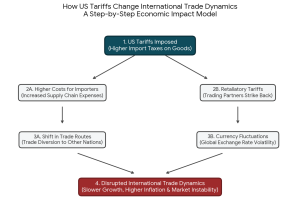
The imposition of US tariffs on imported products continues to play a significant role in shaping the landscape of global trade in the present day. By tweaking these tariff rates strategically, economic authorities set off a ripple effect that reverberates through global supply chains, reshaping the pricing dynamics of goods for consumers on a worldwide scale. As production networks adapt to navigate these obstacles, grasping the mechanisms through which US tariffs influence trade protectionism becomes crucial for evaluating national economic expansion and contemporary trade equilibrium.
Global Impact Breakdown of US Tariffs
| Tariff Framework | Macro-Economic Impact | Real-World Retaliation |
|---|---|---|
| Industrial Tariffs | Boosts expenses within the local manufacturing supply chain. | Taxation imposed on equipment utilized in the manufacturing process. |
| Consumer Goods | Causes prompt inflation in the local market prices. | Procuring supplies from various trade organizations instead of the current source. |
| Agricultural Levies | Standard commodity volume trade flows are being disrupted. | Facing retaliatory tariffs are the exports of independent grain. |
Analyzing the Impact of US Tariffs on Global Trade Dynamics
The influence of US Tariffs extends far beyond national borders, influencing global trade dynamics significantly. These tariffs, when imposed by a leading economic player, trigger a chain reaction in the international market. This reaction manifests through currency fluctuations and strategic shifts in trade patterns. Faced with higher operational costs, businesses must decide whether to absorb these expenses or transfer them to consumers. In the long term, the imposition of US Tariffs can prompt companies to rethink their manufacturing locations, leading to a substantial transformation in global infrastructure.
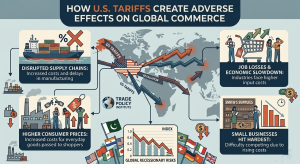
International Trade
In the 21st century, international trade has emerged as a cornerstone of the world economy. Countries no longer rely solely on domestic production but engage in cross-border exchanges of goods, services, technology, and capital. The scale of global trade is immense, with the World Trade Organization reporting that global merchandise trade surpassed $24 trillion in 2024, while total trade in goods and services exceeded $33 trillion. These figures underscore the deep interdependence of economies worldwide.
Global Trade Networks
As globalization has progressed, powerhouse economies like the US, China, Germany, and Japan have gained significant sway over global trade networks. The US, in particular, with its expansive consumer market and robust financial influence, holds a pivotal position in shaping international trade dynamics. Therefore, alterations in US Tariff policies reverberate globally, highlighting the significant impact of protectionist measures on modern commerce. Understanding the historical context of US Tariffs provides valuable insights into how trade dynamics have evolved over time.
International trade denotes the trading of commodities and services among different nations. Countries engage in trade due to varying resources, technologies, skilled workforce, and production capacities. However, the landscape of global trade can swiftly alter with the implementation of measures like the US Tariffs, leading to immediate adjustments in the established resource channels.
Notable Exports:
– China excels in exporting electronics and machinery. – Saudi Arabia is a major exporter of crude oil. – Germany dominates the export market for automobiles and industrial machinery. – Pakistan showcases exports in textiles, rice, surgical instruments, and sporting goods.
Comparative Advantage
The principle of comparative advantage, formulated by economist David Ricardo in 1817, highlights that countries derive benefits by specializing in the production of goods in which they possess relative efficiency and subsequently exchanging them with others.
Exploring the Expansion of International Commerce
In recent decades, there has been a significant increase in global trade.
Historical Growth Table:
| Year | Global Merchandise Trade |
|---|---|
| 1950 | Approximately $60 billion |
| 1980 | Approximately $2 trillion |
| 2000 | Approximately $6.5 trillion |
| 2010 | Approximately $15 trillion |
| 2024 | More than $24 trillion |
| 2025 | Approximately $24.7 trillion |
| 2026 | Projected to exceed $25.4 trillion |
Advancements in transportation, communication technology, container shipping, and trade liberalization have fueled this expansion. The establishment of the World Trade Organization (WTO) in 1995 played a significant role in boosting global trade by diminishing obstacles and fostering consistent trade regulations.
Exploring the Impact of Global Trade on the World Economy
Enhanced Economic Expansion
International trade enables nations to tap into broader marketplaces, empowering enterprises to boost output, attain economies of scale, and foster greater income generation. As a case in point, China witnessed a swift surge in its exports post its WTO accession in 2001. Over the span of 2001 to 2020, China’s GDP skyrocketed from around $1.3 trillion to exceeding $14.7 trillion, solidifying its position as the globe’s second-largest economic powerhouse. For further insights on Economic Growth:
- A Global Perspective with Emerging and Fast-Growing Economies
- Understanding Tariffs
- A tariff is a tax imposed on imported goods.
Practical Illustration:
Let’s consider a scenario where an overseas enterprise ships an item valued at $100 to the United States. When the U.S. administration enforces a 25% tariff, the total cost of the product increases to $125 prior to being accessible to consumers.
Why Governments Impose Tariffs:
Ensure the safeguarding of local industries against international competition, decrease trade imbalances through the reduction of import tariffs, boost governmental income, uphold national security interests, and enhance bargaining power in trade talks.
Raising tariffs in the United States
Is a strategy aimed at safeguarding local industries.American policymakers frequently claim that domestic manufacturers encounter unjust competition from cheaper imports. To illustrate, tariffs were imposed on imported steel and aluminum in 2018 to bolster U.S. producers.
Minimizing Reliance on Overseas Manufacturing
The global supply chains were revealed to have significant weaknesses during the COVID-19 pandemic. Consequently, policymakers in the United States have been placing greater emphasis on promoting local manufacturing within key sectors like semiconductors and pharmaceuticals.
Tackling Trade Disparities
The year 2024 saw the United States grappling with a goods trade shortfall surpassing $1 trillion, prompting certain policymakers to propose tariffs as a means to curtail imports and promote local manufacturing.
Geopolitical Dynamics in Trade
Geopolitical factors play a pivotal role in shaping trade strategies. The rivalry between the United States and China has led to heightened tariffs on a range of items, particularly in the realm of advanced technologies.
Analyzing the Contemporary U.S.-China Trade Conflict
A contemporary and substantial trade conflict unfolded between 2018 and 2020, marking a pivotal moment in global economic relations.
Notable Developments:
In 2018, the United States initiated tariffs on Chinese imports amounting to around $250 billion. China countered in 2019 by imposing retaliatory tariffs on goods originating from the U.S. Despite the signing of the “Phase One” trade deal in 2020, a considerable number of tariffs persisted between the two nations.
Various research studies indicated that these tariffs led to heightened expenses for numerous enterprises and consumers, alongside disrupting worldwide supply chains.
America Holds the Title of the World’s Largest Consumer Market
With a nominal GDP surpassing $30 trillion by 2025, the U.S. economy stands as the biggest globally. Businesses across the world heavily rely on American consumers to sustain their profitability.
Interconnected Global Supply Chains
Today’s manufacturing processes span multiple nations. Take, for instance, an American-sold car that may incorporate:
– Steel sourced from Canada – Electronics from South Korea – Components from Japan – Final assembly completed in Mexico When tariffs impact one production stage, it often triggers cost escalations throughout the entire supply chain.Market Response in the Financial Sector
U.S. trade policy announcements swiftly influence various economic aspects, where investors keenly observe:
– Global stock markets – Commodity prices such as oil and metals – Currency exchange rates – Long-term investment decisions by businessesAdaptation of Strategies by International Corporations
In response to tariff hikes, multinational companies may promptly make strategic moves such as: – Shifting manufacturing facilities to tariff-exempt countries – Diversifying their global suppliers – Exploring alternative export markets beyond the U.S. – Implementing price hikes for end consumers These strategic shifts have repercussions on employment and investments across multiple countries.Do Other Nations Need to Mimic U.S. Tariffs? The straightforward answer is No. The United States lacks the legal mandate to enforce identical tariffs on sovereign nations. Nonetheless, due to the crucial American market, many governments and businesses adjust their approaches to sustain access to U.S. consumers. In reality, U.S. trade policies shape global practices mainly through economic supremacy rather than legal jurisdiction.
Evaluation of Tariff policy:
| positive | negative |
|---|---|
| Supporting local businesses can be seen as a positive move, yet it might be viewed negatively by those advocating for free trade. | Raising prices for consumers |
| Encouraging the growth of employment opportunities within the community | Efficiency in trading needs to be improved. |
| Produce income for the government | Stir up conflicts in trade relations |
| Support the manufacturing industry on a community level. | Discase interruptions in the flow of supplies.upt supply chains |
| Enhance key industries | Experiencing a sluggish pace of worldwide economic expansion |
Final Summary
The global economy has undergone a significant transformation due to international trade, leading to enhanced economic growth, job opportunities, innovation, and a wider range of products for consumers. Since 1950, the volume of global trade has surged from around 60 billion dollars to over 24 trillion dollars in merchandise trade by 2024, underscoring the deepening interconnectedness among nations. Given the United States’ position as the world’s largest economy and a major destination for imports, its tariff policies exert considerable influence on businesses, governments, and investors worldwide. While other countries are not obligated to mirror U.S. tariffs, they often recalibrated their approaches and plans due to the economic significance of accessing the American market. In the dynamic landscape of international trade, comprehending the intricate dynamics between global trade, tariffs, and economic influence will continue to be crucial for policymakers, businesses, and scholars aiming to navigate the complexities of an increasingly interwoven world economy.
References & Further Reading

As an economics writer at Tech and Tips Economy, Siraj Ullah focuses on demystifying economic policies and financial data. His primary goal is to ensure that general economic topics are clear and easy to understand for the everyday reader. By adjusting the depth and length of his articles based on topic complexity, Siraj works tirelessly to bring approachable economic insights directly to his audience.
NICE TO
NIECE
knowladge