
Table of Contents
Exploring the Significance of International Unemployment Risks:
The issue of global unemployment is a significant economic challenge for nations worldwide. This problem arises when individuals who are ready and capable of working struggle to secure appropriate employment opportunities. The repercussions of a soaring unemployment rate extend beyond individual and familial spheres, impacting economic expansion, diminishing consumer expenditures, and escalating societal issues. In the contemporary era of interconnectedness, unemployment crises in a specific region possess the power to swiftly reverberate across numerous other nations, shaping economic landscapes on a global scale.
The Relationship Between Worldwide Joblessness and Regional Impoverishment:
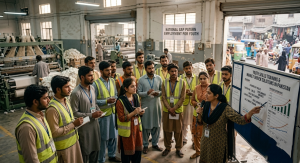
The deceleration in global labor markets poses a direct risk to the economic well-being of developing regions. As international business networks experience downturns, the ripple effect of global unemployment restricts job opportunities across borders, impacts foreign investment streams, and initiates a chain reaction that adversely affects fragile local economies. In nations such as Pakistan, the absence of overseas employment opportunities leads to a decline in household earnings and a surge in domestic job cuts.
The acceleration of poverty nationwide due to this global crisis manifests in six crucial aspects:
1. Significant reductions in foreign remittance inflows.
2. Substantial decreases in demand for national exports.
3. Restrictions on international youth freelancing opportunities.
4. Heightened inflation affecting essential domestic commodities.
5. Strain on government budgets allocated for social safety nets.
6. Escalating domestic job cuts as a result of disruptions in global supply chains.
Current Global Unemployment Situation
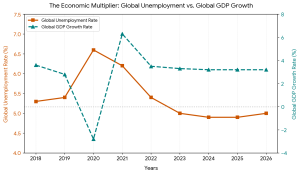
Recent global financial data indicates that the current global unemployment rate fluctuates between 4.8% and 5.0%, approaching some of the lowest levels observed in recent decades. However, analyzing this general statistic in isolation can be deceiving, as it conceals significant regional disparities across various continents. While certain developed Western economies demonstrate robust job growth, the overall economic metrics in less developed regions present a contrasting scenario. Within these emerging areas, domestic financial infrastructures continue to struggle with ongoing issues such as acute labor scarcities, extensive underemployment, and unstable informal employment channels that do not offer sustainable financial stability.
Selected Global Unemployment Rates (Recent Data)
| Country | Unemployment Rate |
|---|---|
| United States | 4.3% |
| Pakistan | 7.1% |
| Canada | 6.6% |
| Global Average | Around 4.8%–5.0% |
Diverse labor market conditions are depicted in these statistics, highlighting significant variations among economies. In addition to unemployment, climate change poses a substantial risk to economic prosperity.
Unemployment Rate in the United States
The global economic landscape still counts the United States as one of its major players. According to the latest labor market statistics, the unemployment rate in the U.S. is hovering around 4.3%. Over the past few months, sectors like healthcare, hospitality, and local government have witnessed significant job growth within the American economy.
Why U.S. Job Shifts Trigger Widespread Global Unemployment
Due to its role as a significant consumer and importer, alterations in the labor market of the United States can have repercussions on numerous nations. For instance:
– An uptick in employment within the U.S. results in a surge in consumer expenditure.
– The heightened expenditure leads to an increased need for foreign goods.
– Nations focusing on exports profit from a robust demand from the U.S.
– There is an expansion in global trade and investment activities.
– Conversely, a rise in unemployment within the U.S. could lead to a decrease in imports and a deceleration in global economic expansion.
How Global Unemployment Affects the Global Economy
1. Reduced Consumer Spending
As individuals face job losses, their expenditure on products and services decreases, leading to a decline in business earnings and a deceleration in economic operations. To illustrate, in a scenario where a million employees lose their jobs and each cuts back on $5,000 per year, the overall consumer demand diminishes by approximately $5 billion.
2. Slower Economic Growth
Productive workers are crucial for driving economic growth. When there is high unemployment, a significant portion of the workforce is idle, leading to a decrease in overall output. Nations with robust labor markets typically outpace countries grappling with prolonged unemployment in terms of GDP growth.
3. Increased Government Expenditure
In times of escalating unemployment rates, governments frequently extend unemployment benefits, welfare support, and training initiatives. As joblessness surges, governmental expenditures rise concurrently with a decrease in tax income, leading to strain on public budgets.
4. Higher Poverty and Inequality
The impact of unemployment on household income is significant. Prolonged joblessness contributes to higher poverty levels and exacerbates income inequality.
5. Social and Political Challenges
The presence of elevated unemployment rates frequently leads to various negative outcomes including crime, societal turmoil, psychological issues, and political instability. Many nations have witnessed demonstrations and increased political tensions in times of high unemployment.
Pakistan’s Unemployment Situation:
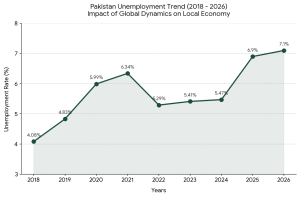
Pakistan’s internal market’s slowdown is intricately linked to global labor disturbances. The country faces significant fiscal hurdles, including skyrocketing inflation, energy scarcity, and currency devaluation, hindering the growth of local businesses. On a larger scale, the escalating global job crisis reduces overseas employment prospects and constricts the crucial remittance channels that support developing countries. Consequently, the combination of these macroeconomic challenges has elevated Pakistan’s unemployment rate from around 5.41% in 2023 to 5.47% in 2024, leaving a substantial portion of the workforce in a precarious financial situation.
Change Over the Last Two Years
Although the increase appears small, it reflects broader economic difficulties.
| Year | Unemployment Rate |
|---|---|
| 2023 | 5.41% |
| 2024 | 5.47% |
The data shows a rise of approximately 0.06 percentage points, equivalent to a nearly 1.1% surge in the unemployment rate during that timeframe.
Why Has Unemployment Increased In Pakistan
Many factors have contributed:
Inflation: Business profitability has been diminished, and household purchasing power has been eroded due to the significant rise in inflation.
Slow Industrial Activity:Numerous manufacturing plants are encountering challenges due to the increasing expenses on energy and constraints on imports, which in turn are restricting their output and recruitment capacity.
Population Growth:Each year, Pakistan experiences a significant increase in its workforce, leading to a pressing need for the creation of millions of job opportunities.
Skills Mismatch: It is a common challenge for numerous recent graduates to secure jobs as their skill sets often do not align with the current demands of the job market.
Real-World Example
Imagine a scenario where a textile plant, with a workforce of 1,000 employees, faces a situation where soaring electricity expenses and dwindling export opportunities compel the factory to scale down its operations, potentially leading to the dismissal of 100 workers.
The ramifications are not confined to the immediate job losses; they trickle down to various facets of the economy. Household earnings dwindle, nearby stores experience a drop in footfall, transportation services witness a decline in passengers, and government revenues suffer a hit. This illustrates the interconnectedness of unemployment across different segments of the economy.
Future Outlook
The global landscape anticipates the emergence of fresh job prospects through technological advancements, digital services, renewable energy, and artificial intelligence. Nevertheless, to capitalize on these developments, individuals will have to equip themselves with contemporary skill sets.
In Pakistan, pivotal measures such as enhancing education, vocational training, modernizing manufacturing and agriculture, and bolstering technology sectors are imperative steps towards mitigating unemployment rates and fostering economic advancement.
Conclusion
Unemployment persists as a significant economic concern impacting individuals, enterprises, authorities, and entire countries. Despite the global unemployment rate resting at unprecedented lows presently, several nations confront labor market hurdles. The United States sustains an unemployment rate hovering around 4.3%, contrasting with Pakistan where the unemployment rate has experienced a slight increase in recent times. To foster job creation and enhance living standards universally, sustainable economic expansion, investments, and workforce enhancement stand as pivotal measures.
References
international labour organisation (ILO)
Pakistan Economic Survey 2025 2026 Finance Division

As an economics writer at Tech and Tips Economy, Siraj Ullah focuses on demystifying economic policies and financial data. His primary goal is to ensure that general economic topics are clear and easy to understand for the everyday reader. By adjusting the depth and length of his articles based on topic complexity, Siraj works tirelessly to bring approachable economic insights directly to his audience.
good one
Best and information topic