
Table of Contents
Understanding the Role of Interest Rates in Global Economic Growth:
Interest rates play a crucial role in shaping global economic growth within the modern macroeconomic framework. They heavily influence borrowing trends, capital investments, inflation levels, and labor market dynamics on a global scale. Monetary policy adjustments by central banks, such as changes to benchmark rates, have immediate and far-reaching effects across national borders, triggering a cascade of consequences throughout the global financial system. However, the impact of these monetary policy shifts varies between advanced economies and emerging markets due to disparities in economic resilience, financial infrastructure, and vulnerability to sovereign debt crises. In parallel, an increasing number of economists and financial experts are exploring alternative economic models to reduce reliance on interest-bearing debt structures.

About Interest Rates On Global Economic Growth:
In its core objective, the impact of interest rates on the global economy is significant. Essentially, interest rates signify the cost of borrowing money annually or the return earned on saving funds. Central banks of nations strategically adjust interest rates to manage liquidity, influence market consumption, and stabilize prices against inflationary pressures. Given the interconnected nature of financial markets, interest rate changes in major economies can have ripple effects worldwide
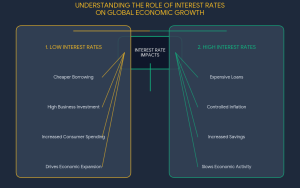
When interest rates increase:
- Loans become more costly.
- Consumer spending decreases.
- Businesses scale back investments.
- Economic growth potentially slows down.
Conversely, when interest rates decrease:
- Borrowing becomes more affordable.
- Consumer expenditure rises.
- Businesses expand their activities.
- Economic growth typically gains momentum.
Effects on International Investment
When central banks in leading developed nations raise their benchmark interest rates, it inevitably draws the attention of international institutional investors looking for enhanced returns on their investments. This shift in focus leads to a substantial flow of investment towards these lucrative markets, causing developing countries and emerging economies to experience substantial capital outflows and devaluation of their currencies.
Impact on Global Trade
When interest rates fluctuate, exchange rates are impacted. A nation with elevated interest rates could witness a surge in its currency value. Consequently, a strengthened currency might lead to pricier exports, diminished global competitiveness, and escalated imports. Such shifts play a pivotal role in shaping worldwide trade dynamics and the economic ties among nations.
Impact on Government Debt
Governments around the world frequently resort to borrowing funds to support various development initiatives and public amenities. When debt accumulates without adequate consideration of debt serviceability, the increasing debt liabilities can place strain on future public budgets. A greater share of sovereign revenue may be requisite for debt management of developmental frameworks, education, healthcare, or other strategic agendas. Effective debt mitigation can support regulators in preserving fiscal maneuverability during periods of economic distress.
Elevated interest rates lead to an escalation in:
Nations with substantial debt burdens find themselves especially exposed to risks when interest rates surge on a global scale.
- Expenses related to servicing debts.
- Widening budget deficits.
- Intensified financial strain on governmental entities.
Effects on Inflation
One of the most significant dilemmas faced by policymakers globally is striking the perfect balance between using high interest rates to curb inflation, which may lead to lower price hikes, and the risk of dampening economic growth and raising unemployment levels.
Interest Rates on Global Economic Growth Impact on Developed Economies:
When examining the impact of interest rates on global economic growth, it becomes evident that advanced economies respond diversely owing to their varying economic prowess. These developed markets leverage robust financial frameworks, extensively diversified industrial landscapes, and tightly regulated banking systems to cushion abrupt monetary policy changes successfully.
Advantages:
Advanced countries like the United States, Germany, and Japan employ interest rate strategies to proficiently control inflation levels.
- Encouraging saving and enhancing financial stability among households are potential benefits of higher interest rates.
- Sophisticated financial systems in developed economies are better equipped to withstand economic shocks.
| Country | 2024 GDP | GDP Growth | Inflation | Monetary Policy Evidence |
|---|---|---|---|---|
| United States | 28.75 trillion | 2.8% | 2.9% | The Federal Reserve sustained Comparatively increased interest rates during 2024 to decrease inflationary pressure while permitting economic activity to continue. |
| Germany | 4.69 trillion | -0.5% | 2.3% | Germany operated under the ECB’s contractionary monetary policy, which was designed to restrain demand and slowly foster inflation near to price-stability objectives. |
| Japan | 4.03 trillion | 0.1% | 2.7% | The Bank of Japan evolved systematically away from its ultra-low interest-rate strategy and elevated its short-term rate while anchoring accommodative economic conditions. |
Adverse Consequences
- Economic Downturn Slows
- Businesses may hesitate to expand and consumers to spend due to elevated borrowing expenses.
- Decline in Corporate Investments
- Costly financing might lead companies to delay their projects.
- Vulnerability in the Housing Market
- Increased mortgage rates can dampen housing demand and devalue properties.
- Resilience of Developed Economies
- Despite obstacles, advanced economies are bolstered by robust institutions that aid in rebounding from economic slumps.
- Effects on Emerging and Underdeveloped Economies
- Developing nations typically encounter heightened challenges amid global interest rate hikes.
Increased Debt Burden
In numerous developing countries, foreign loans play a crucial role in financing infrastructure and fostering economic growth. However, when interest rates surge, several consequences unfurl: loan repayments escalate, governmental budgets face strain, and the execution of development initiatives might encounter delays.
Currency Depreciation
When seeking higher returns, capital outflows from developing nations can potentially lead to currency depreciation and higher import costs. A declining exchange rate can slowly change the expenditure pattern of an economic system, specifically when basic goods are imported. Increased import bills are passed through to domestic prices, influencing consumer budgets as well as firm costs. If this stress continues, the economy may face significant challenges in sustaining price stability and preserving overall economic activity.
Rising Inflation
When a currency depreciates, foreign goods become more expensive, driving inflation and reducing purchasing power. As the cost of critical inputs rises, firms may pass part of the extra expense on to buyers. This can gradually raise the prices of everyday goods and services across the local market. Sustained high prices can strain consumers’ budgets, especially when real earnings do not rise in tandem. With reduced purchasing power, customers may cut spending on nonessential products and adjust their consumer behavior.
Reduced Foreign Investment
Safer markets offering higher returns might be favored by investors, potentially limiting investment prospects in emerging economies. When global investors become more cautious, industrializing nations may acquire fewer assets for new firms, supply-chain infrastructure, and upswing programs. Lower resource allocation can also decrease possibilities for technology transfer, job creation, and improvements in economic capability. If these conditions prevail, firms may find it more difficult to procure the capital needed for sustainable economic development. Poor capital flows can add extra stress on development prospects.
Increased Poverty and Unemployment
Excessive interest rates can hinder the expansion of businesses, resulting in decreased job opportunities and slowed economic progress. Countries like Pakistan, Bangladesh, and Nigeria often encounter significant obstacles when faced with a rapid increase in global interest rates. Relying too heavily on interest-based financial systems can give rise to various economic challenges, including mounting debt burdens, financial disparities, instability in the economy, speculative bubbles in financial markets, banking crises, and the concentration of wealth among lenders. When excessive debts accumulate among governments, businesses, and households, economic shocks tend to have more profound impacts. The 2008 global financial crisis served as a stark reminder of how financial systems fueled by debt can lead to widespread economic turmoil.
Islamic Finance as an Alternative:
Islamic finance operates on principles originating from Islamic economic doctrines. An essential aspect of this system is the prohibition of interest (Riba). Instead of relying on fixed returns from interest, Islamic finance prioritizes profit and loss sharing, asset-backed financing, ethical investments, and risk-sharing among involved parties. Such an approach is designed to promote a more equitable and enduring financial framework, aiming to mitigate economic risks effectively. Learn more about the potential of Islamic Finance in diminishing economic risks.
Lower Debt Dependency
Islamic financial institutions promote investments tied to genuine economic activities rather than excessive reliance on borrowing, which helps mitigate the accumulation of unsustainable debt. By connecting funding with physical capital and profit-yielding initiatives, this model can promote more regulated use of assets. It may also mitigate the strain that excessive leverage can impose on firms and monetary and financial frameworks over time.
Risk Sharing
In the realm of traditional finance, it is common for borrowers to shoulder the majority of the risk. Conversely, Islamic finance model ensures a fairer distribution of risk between investors and entrepreneurs, fostering a balanced and mutually beneficial relationship.
Support for Productive Investment
Investments in Islamic financial agreements often necessitate links to physical assets or operational endeavors, fostering capital allocation into sectors that yield tangible economic benefits. This link can channel capital market fundraising toward firms and programs that add to productive output and economic processes. As a result, investment can foster private sector growth, job creation, and the expansion of manufacturing and supply chains.
Greater Financial Stability
Islamic finance’s emphasis on discouraging speculative excess could potentially play a role in mitigating financial instability and the formation of market bubbles. By targeted more closely on foundational economic processes, this financial concept may support heightened scrutiny of financial transactions. It can also promote sharper focus on the financial placements and objectives of portfolio allocations.
Ethical Economic Development
Investments in line with Islamic finance focus on generating returns that contribute positively to society, steering clear of any practices deemed detrimental or unethical. This concept can prompt investors to evaluate the socio-economic and economic impact of their financial decisions. It may deploy capital toward firms and programs that produce gainful goods, services, and job creation. Consequently, financial operations can remain intertwined with larger economic growth rather than concentrating exclusively on short-term financial advantages.
Successful Examples of Islamic Finance
Many sovereign states have developed strong Islamic finance sectors. Economies like Malaysia, the United Arab Emirates, Saudi Arabia, and Bahrain have consolidated organizational and liquidity hubs that help Shariah-adherent banking and investment. Their precedents reflect how an interest-free financial system can operate simultaneously with traditional institutional frameworks while facilitating various categories of market participants and firms. The segment has also scaled up via Islamic sukuk, mobilized liquidity reserves, and other funding mechanisms. These evolution has facilitated Islamic finance as a part of growing prominence within the cross-border monetary environment.
| Country | 2024 GDP | GDP Growth | Islamic Finance Evidence |
|---|---|---|---|
| Malaysia | $422.2 billion | 5.1% | Malaysia’s broad halal economy accounted for 7.5% of GDP in 2020. Islamic finance is one of the primary components supporting this economic system. |
| United Arab Emirates | 552.3 billion | 4.0% | The UAE has merged its leading Islamic banking and financial-market organization, but a credible isolated percentage of GDP uniquely linked to Islamic finance is not reported |
| Saudi Arabia | 1.24 trillion | 2.0% | Islamic banking constitutes a substantial segment of Saudi Arabia’s financial system, but its direct driver as a percentage of total GDP should not be reflected as a distinct GDP share without precise official calculations. |
| Bahrain | 47.11 billion | 2.6% | Bahrain has advanced dedicated Islamic-finance system, encompassing Shariah-adherent banking and asset-management organizations, but no credible independent Islamic-finance GDP percentage is accessible. |
Comparison of Two System: Conventional Rate and Islamic Finance
| Measure | Interest-Rate Group | Islamic-Finance Group |
|---|---|---|
| Countries compared | 3 | 4 |
| Combined 2024 GDP | 37.47T | $2.26T |
| Highest 2024 growth | 2.8% — United States | 5.1% — Malaysia |
| Lowest 2024 growth | -0.5% — Germany | 2.0% — Saudi Arabia |
| Main financial characteristic | Policy interest rates are primary monetary policy tools | Shariah-compliant financing models alongside broader economic frameworks. |
Which Financial Approach Offers Greater Benefits?
Based on the comparison, Islamic finance is emerging to offer wider benefits in regions where funding is linked to real assets, trade flows, efficient investment, and joint ventures. Its framework can prompt resources to move toward genuine economic activities and can serve as a substitute for consumer financing in conventional lending.
However, traditional lending rate systems have a distinct advantage in monetary policy. Central banks can calibrate interest rates to steer lending, saving, business investment, inflation, and economic demand. This makes conventional monetary systems a widely adopted benchmark for managing shifting economic conditions.
From an analytical perspective, Islamic finance has a significant advantage in linking economic activity to the productive sector, while the traditional system is more effective at implementing an adjustable interest-rate model for economic stabilization. Therefore, if the comparative analysis is particularly about collateralized and equity-based finance, Islamic finance offers substantial benefits; if the target is monetary policy management, typical interest-rate systems provide essential instruments.
The 2024 GDP figures alone cannot demonstrate that either system globally generates pronounced macroeconomic advantages because expansion is also shaped by trade, business investment, regulatory authorities, natural resources, output efficiency, population dynamics, and the international economic scenario. The deeper analytical takeaway is that Islamic finance provides a divergent financial framework with distinct inherent advantages, while traditional finance is based on monetary policy instruments that the economic system can use to control financial cycles.
Macroeconomic Framework Assessment
Throughout this article, interest rates and their function as an anchor in the economic process are examined. After these core concepts are analyzed, a systematic perspective is applied to evaluate how they affect the macroeconomic framework. This assessment is based on economic principles, derived from an objective observation of this topic. Rather than a statistically verified claim, this study offers a qualitative analytical review.
Impact of Interest Rates
From an economic perspective, the variable borrowing costs may yield notable structural benefits to creditors and can also be utilized by central banks as a monetary-policy tool. A contrasting dimension emerges when evaluating the conditions of the individuals or organizations bearing the debt. The debtors have to bear the extra financial cost, and these liabilities can become increasingly complex when credit acquisition continues for a long time. Consequently, this raises a fundamental question about whether economic systems should focus only on the benefit produced by money or also examine the greater downstream financial effects of outstanding borrowings.
Why Islamic Finance Caught Attention
While examining Islamic finance, a comprehensive understanding of its models is derived from various concepts. Its emphasis on real assets, trade flows, business investment, and participation-based economic results ensures that financial activity is closely aligned with the actual economy. In economic terms, when funding is connected to productive economic transactions, it remains more directly tied to the underlying assets or capital. This serves as one of the primary reasons why this discrete financial paradigm is deemed critical when articulating economic welfare.
What We Have Learned About Successful Economies
Another key insight derived from this article is that the robustness of an economy cannot merely be explained by the use of monetary rates. When we look at emerging economies, strategic decision-making, growth-oriented investment, technological advancement, import and export flows, institutional strength, and fiscal governance can have a profound impact on growth. Concurrently, increasingly industrialized countries can encounter substantial debt liabilities. This underscores that interest rates themselves should not be managed as the single explanation for economic success.
Thought About the Future of Finance
Derived from everything examined in this article, it can be argued that the international economic system should critically examine mitigating asymmetry in interest-based loans. If a country does not adopt the Islamic framework, it could alternatively analyze ways to limit the strain caused by increasing interest rates. Optimizing anchored borrowing costs, implementing statutory caps on interest rates, or alternative funding architectures could be evaluated as strategic trajectories.
Final Understanding
This study offers a comprehensive synthesis of foundational economic models, focusing on the structural differences between debt-driven and asset-backed systems. The conclusion drawn within this review provides an objective, analytical evaluation of current global interest rate environments. Rather than making absolute predictions, it establishes a theoretical baseline to understand how sovereign economies adapt to shifting monetary instruments. Ultimately, it provides a contemporary understanding of this subject and explains the direct impacts on economies, financial intermediaries, and the wider public. From a macroeconomic perspective, a financial system should not only generate profits but also foster productive activity, long-term sustainability, and society’s socioeconomic well-being.
Final Statement
References

As an economics writer at Tech and Tips Economy, Siraj Ullah focuses on demystifying economic policies and financial data. His primary goal is to ensure that general economic topics are clear and easy to understand for the everyday reader. By adjusting the depth and length of his articles based on topic complexity, Siraj works tirelessly to bring approachable economic insights directly to his audience.