
Table of Contents
Economic Policy and Decision Making
National economic policies and decision-making serve as the primary steering mechanisms that dictate a country’s financial trajectory and macroeconomic stability. Sovereign governments, central banks, and global monetary institutions continuously enforce fiscal and monetary frameworks that directly govern industrial output, labor market trends, inflationary pressures, and the overall quality of public life. Well-structured economic plans are essential to keep markets stable, help domestic businesses grow efficiently, support strong consumer purchasing power, and encourage capital investors to commit safely to long-term infrastructure.
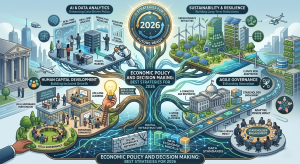
Strategic Policy Framework & Analysis
The backbone of overseeing a country’s finances lies in the organizational systems established by governmental bodies and financial establishments to supervise economic well-being. Opting for strategies that focus on sustainable economic policies and prudent decision-making provides leaders with the tools to ensure lasting stability in the markets. These deliberate actions help maintain a harmonious equilibrium by promoting steady growth, managing inflation, safeguarding employment opportunities, and fostering equitable wealth distribution among citizens. Given the volatile nature of the world economy, emphasizing effective economic policies and decision-making acts as a crucial defense mechanism shielding local markets from abrupt financial upheavals. There are typically two primary classifications of economic policies:
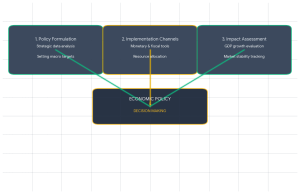
Fiscal Policy
Governments make decisions about taxation and public spending through fiscal policy, which aims to impact economic activity and attain specific economic objectives. Via shifts in taxes and public spending, policymakers can impact private consumption, firm investment, job creation, and aggregate demand. At the time of poor economic activity, governments may increase spending or decrease taxes to support the financial system. On the other hand, elevated taxes or reduced public spending may be utilized when demand and inflationary forces become massive. Fiscal policy therefore serves as a key instrument for controlling economic situations and helping long-term growth.
In times of economic downturn, boosting public expenditure can serve as a catalyst for economic expansion. Lowering tax rates has the potential to elevate disposable income levels and foster heightened consumer expenditure. Imposing higher taxes could play a role in curbing inflation rates and alleviating budget shortfalls. Fiscal strategies are commonly employed to mitigate economic volatility and bolster enduring initiatives like infrastructure enhancements, educational advancements, and healthcare systems.
Monetary Policy
A nation’s central bank is responsible for overseeing monetary policy, which centers around regulating the money supply and interest rates. Its core toolkit includes adjusting benchmark interest rates to manage market liquidity. Through these strategies, the central bank can influence lending costs, consumption behavior, business investment, and the aggregate speed of adjustment in economic growth. The effectiveness of monetary policy relies on how adjustments transmit through the broader economy and impacts domestic units and firms.
Conducting open market operations
Should market inflation surge above acceptable levels, regulatory institutions frequently increase lending rates to limit public spending and borrowing accessibility. Conversely, in times of economic downturn, monetary bodies typically lower these interest indicators to encourage corporate investments and boost consumer demand.
The Importance of Economic Policy and Decision Making
Making decisions pertaining to economic policy entails choosing the optimal course of action from a range of options, taking into account the available resources and potential outcomes. Such decisions, when made effectively, can play a crucial role in fostering sustainable economic growth, diminishing unemployment rates, ensuring price stability, promoting investment and innovation, as well as enhancing living standards.
Strengthen public confidence in the economy
Making bad choices in the economy can result in inflation, economic downturns, job losses, and hindered economic expansion. Misguided economic decisions can generate budgetary pressures, including high prices, downturns, rising joblessness, and diminished long-term growth. Ultimately, these impacts can also prove disruptive for firms and families planning and making optimistic financial commitments.
Crucial Role in Shaping Economic Policies and Decision-Making:
Economic policies are carefully drafted by policymakers after taking various factors into consideration. These factors help regulators grasp economic situations, pinpoint arising difficulties, and examine relevant policy responses. Economic growth, purchasing power, job creation, public finances, global trade, and the overall positions of domestic units and firms can all impact policy decisions. Considering these components together allows policymakers to design strategies that counter present economic demands while promoting greater financial stability and sustainable growth.
Economic Growth
In most cases, an expanding economy leads to the creation of additional jobs, increased earnings, and enhanced business prospects. Governments frequently formulate strategies aimed at promoting investment, fostering entrepreneurship, and boosting productivity.
Inflation
Evaluating the pace at which prices rise over a period is what defines inflation. While a certain level of inflation is expected, an overly high inflation rate can diminish buying ability and lead to economic instability. Hence, policymakers pay close attention to inflation levels while formulating economic strategies.
Employment Levels
When unemployment rates soar, they can inflict harm on economic productivity and diminish consumer expenditures. In response, authorities might implement initiatives to foster job growth or provide incentives to bolster business activities and generate more job openings.
Public Debt
Fiscal policy decisions are affected by government debt. Long-term financial difficulties can arise from excessive borrowing, whereas maintaining responsible debt management promotes economic stability. A regulator must therefore contemplate how much liability the economy can control without imposing massive stress on subsequent fiscal horizons. Risk-aware asset leveraging can help efficient investment, while unchecked liability expansion may reduce the funds accessible for public services and developmental infrastructure.
International Trade
The impact of trade policies extends to exports, imports, foreign investments, and exchange rates. Nations frequently modify their trade strategies in efforts to enhance competitiveness and bolster economic expansion. Typically, the process of making economic decisions adheres to a set structure.
- The first step is to identify an economic issue such as high inflation, measured growth, or high unemployment.
- Policymakers examine various economic indicators such as GDP growth, inflation rates, employment figures, and trade balances to make informed decisions.
- Various policy options are evaluated based on their associated costs and benefits.
- The proper policy is put into steps through ratification regulations, or monetary measures.
- The effectiveness of policies is enhanced and unintended consequences are minimized through ongoing evaluation by authorities, who make necessary adjustments as needed.
Challenges in Economic Policy and Decision Making:
Economic decision-making is infrequently easy. Policymakers face many problems:
- Economic situation can change vastly due to political tension , natural disasters, pandemics, or financial crises.
- Balancing economic objectives can be challenging as pursuing one goal might hinder another.
- For instance, the endeavor to curb inflation by raising interest rates could potentially dampen economic expansion.
- Political factors frequently come into play for governments, shaping their economic choices.
Global Economic Interdependence
Domestic economic performance can be influenced by international events in a globalized economy, thereby constraining policymakers’ ability to fully dictate outcomes. Shifts in international trade, power sector prices, financial markets, and supply lines can rapidly impact firms, buyers, and overall national economies.
Technology and Modern Economic Policy and Decision Making:
The landscape of economic policy analysis has been revolutionized by technological progress. Big data, artificial intelligence, and sophisticated economic models are now utilized by governments and central banks to enhance forecasting accuracy and policy assessment. These digital tools offer instantaneous data that enables policymakers to address economic hurdles with greater efficiency. Furthermore, fintech breakthroughs are restructuring banking, payment, and investment frameworks on a global scale.
Strategic Economic Policy and Decision Making for Sustainable Development
Sustainability has become a central theme in contemporary economic policy and decision-making processes, wherein policymakers are diligently working to harmonize economic growth, environmental protection, and social equality. Although the immediate implementation of stringent green regulations may pose challenges such as operational hurdles and potential economic slowdown, the adoption of sustainable practices is indispensable. By safeguarding finite resources, minimizing climate-related crises, and ensuring enduring global prosperity for upcoming generations, these strategies prove to be crucial in the grand scheme of things.
Key focuses encompass:
By implementing sustainable economic strategies, we guarantee that upcoming generations can enjoy ongoing economic advancement while preserving our natural resources.
- Investing in eco-friendly initiatives
- Advancing renewable energy sources
- Developing sustainable infrastructure
- Alleviating poverty
- Promoting financial inclusivity
Economic Policy and Decision-Making: A Test of Resilience During Crisis
In my point of view, economic decision-making and policymaking play a critical role in determining how an economy reacts to both common problems and unpredictable crises. This concept is implemented not only to regulate but also to guide businesses, domestic units, and people. A person who continually makes weak budgetary decisions can slowly fall into severe hardship; similarly, imprudent investment moves at the state level can turn an unforeseen global event into a significantly greater economic recession.
The divergence becomes particularly evident when economies face unforeseen global events. A catastrophe does not always originate within an economy. Warfare, geopolitical tensions, widespread epidemics, energy crises, economic tremors, and disruptions to global trade can arise beyond territorial boundaries. However, the way regulators, monetary authorities, firms, and other organizations respond can affect how profoundly those external disruptions influence local economic positions.
The COVID-19 global outbreak severely impacted output, job creation, imports, exports, and domestic unit revenue globally. Before economies had fully recovered from that disruption, the Russia-Ukraine war generated another major crisis via energy, food, commodity, and trade channels. The World Bank acknowledged that the war elevated to higher food and fuel prices, cost-push inflation, rigid economic positions, and poor commercial activity in several economies.
Most recently, diplomatic tensions in the Middle East have proven once more how rapidly developments in one territory can impact economies beyond the immediate combat zone. In 2026, disturbances stemming from the Israel-Iran-U.S. conflict and the Strait of Hormuz have moved energy markets and shipping routes, generating extra risks for countries that rely massively on imported oil and gas. News agencies have declared considerable reduction in shipping traffic via the Strait, while renewable energy-market dislocations have also impacted countries like India, China, and Pakistan.
These illustrations reflect why economic strategy cannot be grounded only in a normal economic climate. Policymakers must also be ready for conditions in which fuel prices are skyrocketing, supply lines are suspended, exchange rate pressures are elevated, or global trade becomes unpredictable. A country with robust economic safeguards, diversified energy sources, healthy external reserves, and adaptable policy instruments may have more room to absorb such shocks than an economy with limited policy space.
Japan: From Wartime Destruction to Economic Recovery
Japan provides a crucial classic case of how economic coordination, business investment, effectiveness, and organizational policy can contribute to rehabilitation after intense destruction. Following World War II, Japan confronted major economic complications, alongside widespread economic instability. During this period, the country carried out structured central planning and accomplished rapid growth. IMF historical interpretation logs powerful investment, expanding trade, Output maximization, and economic planning as crucial components of Japan’s post-crisis restoration.
Japan’s trajectory does not imply that strategy alone shaped its economic performance. Public investment, manpower, global trade, technological advancement, and other structural elements were also significant. However, the case explains how a country can react to intense disruption by re-establishing operational capacity and developing sustained economic objectives rather than dealing with a crisis only as a fleeting disruption. Japan’s peacetime coordination embodied a 5-year agenda for economic self-support and later the Income Doubling Plan, which provided a model for its rapid growth
Pakistan and the Importance of Crisis Management
Pakistan also furnishes a gainful illustration of how strategy can impact the economic implications of an external crisis. During the COVID-19 pandemic in 2020, the country confronted an acute stoppage of economic activity and unprecedented lockdowns. The regulators unveiled a fiscal stimulus package that encompassed vulnerable households, firms, medical, and basic supplies, while the State Bank of Pakistan profoundly slashed the interest rate during the early months of the global outbreak. The World Bank recorded these as components of Pakistan’s response to the fiscal strain.
Simultaneously, Pakistan’s later struggles with worldwide energy supply and commodity price volatility illustrate the constraints of local strategy when an economy is massively vulnerable to external power dependencies. The Russia-Ukraine conflict imposed extra pressure on South Asian countries via increased oil and food prices, eroded purchasing power, budgetary stress, and current-account deficits.
From my perspective as a learner, maybe I am wrong; this is where the critical relevance of economic decision-making becomes evident. The question is not whether a country can mitigate every crunch; no country can entirely manage conflicts, global outbreaks, geostrategic war, or worldwide resource disruptions. The most crucial reservation is whether its economic institutions are prepared to absorb those shocks and protect households, businesses, job creation, and structural capability.
Economic Resilience Depends on Decisions Made Before the Crisis
An emergency frequently exposes inadequacies that were already present in an economy. If an economic system enters a global supply disruption with elevated external liabilities, liquidity requirements, depleted foreign currency reserves, acute vulnerability to offshore energy assets, poor economic generation capacity, or constrained fiscal flexibility, the tremor can become much more arduous to control. Conversely, robust institutional frameworks, a multifaceted supply base, calculated capital allocation, and timely strategic interventions and reactions can deliver long-term resilience.
This is why I believe economic decision-making is more than merely determining between tax incentives, policy rates, or public spending. It is also about priming an economy for unpredictability. The real power of a regulatory stance model becomes prominent when market conditions abruptly shift, and state authorities have to formulate formidable policy under constraints on time and resources.
Final Remarks
The cornerstone of every economy’s success and stability lies in economic policy and decision-making. Governments and central banks shape growth, employment, inflation, and investment through fiscal and monetary policies. Making impactful decisions necessitates meticulous analysis, credible data, and a forward-looking approach. In the face of evolving global economic hurdles, prudent economic policies continue to be crucial in fostering prosperity, stability, and sustainable progress. Nations that implement well-informed and equitable economic choices enhance their chances of attaining enduring economic prosperity and enhancing the well-being of their populace.
References

As an economics writer at Tech and Tips Economy, Siraj Ullah focuses on demystifying economic policies and financial data. His primary goal is to ensure that general economic topics are clear and easy to understand for the everyday reader. By adjusting the depth and length of his articles based on topic complexity, Siraj works tirelessly to bring approachable economic insights directly to his audience.