
Table of Contents
What is the U.S. Policy on Tariffs and International Trade
Picture a shirt stitched in a factory in Faisalabad, shipped across the Atlantic and hung on a rack in an American store. Its journey crosses oceans, customs offices, and several balance sheets. Now add a new tax at the border, and every step along that path has to be reconsidered: the price tag, the profit margin, the order size, maybe even the factory itself. This is why US tariffs impact Pakistan’s exports and slow down the economy if the US pushes the tariff to be implemented on every country in the world.
That border tax is a tariff, such as one of the US tariffs, and few economic tools stir up as much argument. Supporters see a shield for local workers and a lever for diplomacy. Critics see a hidden levy on ordinary shoppers and a spark for trade wars. Both camps have evidence on their side, which is exactly why the subject deserves a careful, unhurried look rather than a slogan.
Key Points at a Glance
- A tariff is a tax on imported goods, collected when the products enter a country.
- Legally the importer pays it, but the real burden is shared among foreign suppliers, domestic businesses and shoppers. Studies of the 2018 and 2019 tariffs found that American firms and households carried most of it.
- Governments use tariffs to protect industries, raise revenue, answer unfair trade practices, strengthen national security and gain bargaining power.
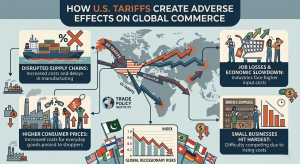
- Side effects include higher prices, retaliation, shifting supply chains and uncertainty that makes businesses hesitate.
- Export-dependent developing economies, including Pakistan, can lose sales or, in some cases, gain customers when buyers look for alternatives.
Tariffs Explained From Scratch
A tariff is simply a tax charged on goods that cross a border. It can be a percentage of the product’s value, known as an ad valorem tariff, or a fixed amount per unit, such as a set sum per tonne of steel. Customs officers collect it when the goods arrive, and the money goes into the national treasury.
A small worked example makes this concrete. Suppose a company abroad sells a machine part to an American buyer for 100 dollars, and the United States places a 25 percent tariff on it. The importer must pay 25 dollars to customs on top of the 100. The part now costs 125 dollars before shipping and markup. What happens next is where the story gets interesting, because someone has to absorb that extra 25 dollars. The foreign seller might cut the price to keep the customer. The importer might accept thinner profits. Or the cost might travel down the line until the final shopper pays it at the checkout. Usually it is some combination of all three.
Tariffs are not the only trade barrier. Quotas cap how much of a product can be imported. Licensing rules, technical standards and customs delays can also slow imports. Economists lump these under the heading of protectionism, and tariffs are the most visible member of the family because they show up directly in prices and in government accounts.
Why Countries Trade in the First Place
To judge tariffs fairly, it helps to understand what they interfere with. Nations trade because no country is good at everything. Some have fertile land, some have cheap energy, some have skilled engineers, and others have huge pools of labour. In 1817 the economist David Ricardo laid out the idea of comparative advantage: even if one country is better at making everything, both sides still gain when each concentrates on what it does relatively best and swaps the rest.
Look at some familiar patterns. China is a heavyweight in electronics and machinery. Saudi Arabia sells crude oil. Germany is famous for cars and industrial equipment. Pakistan exports textiles, rice, surgical instruments and sporting goods. Each of these industries grew in part because buyers abroad were willing to pay for them.
The scale of this exchange is huge. According to World Trade Organization estimates, world merchandise trade was worth roughly 24 trillion dollars in 2024. That is a long way from the early post-war years, and the climb was helped by cheaper shipping, containerisation, better communications and the lowering of trade barriers under the GATT and, from 1995, the WTO.
| Year | World merchandise trade (approximate) |
|---|---|
| 1950 | About 60 billion US dollars |
| 1980 | About 2 trillion US dollars |
| 2000 | About 6.5 trillion US dollars |
| 2010 | About 15 trillion US dollars |
| 2024 | About 24 trillion US dollars |
Trade helped lift whole economies. China’s output grew from a little over one trillion dollars around the time it joined the WTO in 2001 to more than fourteen trillion by 2020, a rise fuelled heavily by exports. For a wider view of how fast-growing economies climb, see our piece on emerging and fast-growing economies.
Why Governments Impose Tariffs
Nobody raises tariffs just for fun. The motives usually fall into a handful of groups, and some are more convincing than others.
Protecting local industries
Lawmakers often argue that home-grown producers face unfair competition from cheaper imports, sometimes subsidised by foreign governments. A tariff raises the price of the imported rival and gives local firms room to breathe. The steel and aluminium tariffs introduced in 2018 followed exactly this logic. The classic version of the argument concerns infant industries: a young sector that needs time to grow before facing global giants.
Reducing trade deficits
A country that buys much more than it sells abroad runs a trade deficit. The Us tariffs has been in that position for decades, and its goods deficit passed the one trillion dollar mark in 2024. Some policymakers see tariffs as a way to push down imports and encourage domestic production. Economists tend to be sceptical, pointing out that deficits also reflect saving and investment patterns, and that a stronger currency can wipe out the effect of a tariff.
Raising money
Before income taxes became common, tariffs were a main source of revenue for many governments, including the early United States. Even now they bring in billions, which makes them attractive during budget squeezes.
National security and resilience
The pandemic showed how fragile global supply chains can be when masks, medicines and chips suddenly became hard to find. That experience strengthened calls to produce critical goods at home or with trusted partners, particularly semiconductors and pharmaceuticals. Tariffs are one tool to push companies in that direction.
Bargaining power
Governments also use tariffs as a threat. The message is: open your market, change your policy or drop your own barriers, or face higher duties. Sometimes this works, and sometimes it simply triggers a counter-move.
Who Really Pays?
Here is a question that surprises many readers: when puts a the US tariff on foreign goods, who pays? The formal answer is the American importer, who writes the cheque to customs. The economic answer depends on how flexible each party is.
If foreign suppliers cut their prices to hold on to customers, they absorb part of the tax. If they refuse, importers must pay more, and then either shrink their profits or raise their own prices. Research on the 2018 and 2019 Us tariffs, including well-known academic studies of customs and price data, concluded that the price increases landed mostly on American businesses and consumers, with foreign exporters cutting their prices only slightly. That finding does not settle every debate, since results vary by product and by period, but it counters the idea that a tariff is simply a bill sent abroad.
The burden also spreads in less obvious ways. A tariff on steel raises costs for carmakers, appliance makers and builders who buy steel, even if they never import a single bar themselves. Local steel producers may enjoy higher prices, but their customers pay for it. Economists call this the cost of input tariffs: duties on materials hurt the very industries that use them.
A Short History of US Tariff Fights
None of this is new. Britain’s repeal of its Corn Laws in the 1840s opened its food market and became a symbol of free trade. They relied on US tariffs heavily in the nineteenth century to fund the government and shelter young industries. The most notorious episode came in 1930, when the Smoot-Hawley Act raised duties on thousands of goods. Trading partners hit back, world trade collapsed and many historians say the episode deepened the Great Depression, although other causes were at work too.
After the Second World War, countries chose a different path. They built the General Agreement on Tariffs and Trade in 1947, later replaced by the WTO, and negotiated duties downward round after round. By the early twenty-first century, average tariffs among major economies were low, and trade grew faster than output.
The mood shifted again in 2018, when imposed the US tariffs on steel and aluminium, then on a wide range of Chinese goods, with coverage eventually reaching hundreds of billions of dollars of imports. China answered with its own duties on American products, including farm goods such as soybeans, which hurt American farmers and led to government aid payments. A “Phase One” agreement in early 2020 calmed the dispute, but many of the tariffs stayed in place.
Where Things Stand
Trade policy moves quickly, so treat this section as a snapshot and confirm details with the sources at the end.
A new wave of US tariffs began in 2025 and covered a far wider group of countries and products than the earlier round. Most of the broad duties relied on a 1977 emergency-powers law. In February 2026, the US Supreme Court ruled against the use of that law for such general tariffs, which forced the administration to look for other legal routes.
Reports from trade analysts say the government then turned to temporary baseline duties under a different statute and, later in the summer, to investigations under Section 301 of the Trade Act that produced new tariffs on dozens of trading partners. Duties imposed under Section 232, which cover specific sectors on national-security grounds such as steel and aluminium, stayed in force.
The effect on the overall level of protection has been large. Estimates from independent research groups put the average effective US tariff rate at roughly 11 percent at its peak in late 2025, compared with only about 2 percent at the start of 2025. Disputes with individual partners, including Canada, have continued to flare up, along with retaliation measures. The central takeaway is not any single rate. It is that the legal basis, the targets and the exemptions have kept changing, and the changes themselves are a cost to businesses that must plan years ahead.
Supply Chains, Currencies and Markets
The car with five passports
Modern products rarely come from one country. A vehicle sold in the United States might contain steel from Canada, electronics from South Korea, parts from Japan and final assembly in Mexico. If parts cross a border several times before the finished product is ready, a tariff can be charged more than once. That is why duties on components can raise costs far more than the headline rate suggests, and why a hit to one link in the chain can ripple through the entire process.
Currency reactions
When a large importer raises US tariffs, its currency often strengthens, since fewer imports mean less demand for foreign money. A stronger dollar partly offsets the tariff for foreign sellers, because their goods become cheaper in dollar terms. At the same time, it makes dollar-denominated debts harder to repay for emerging economies and pushes up the cost of imported oil and food for countries with weaker currencies.
Financial market reactions
Investors respond to Us tariff announcements within hours. Stock indexes can swing, commodity prices adjust and bond yields shift as traders weigh the chance of slower growth against the risk of higher inflation. Big exporters, retailers and carmakers are especially sensitive. The uncertainty itself becomes an economic force, since firms that cannot tell what next year’s duties will be tend to delay hiring and investment.
How Companies Adapt
Faced with new duties, firms rarely sit still. Typical responses include:
- Raising prices: passing part of the cost to shoppers, if competitors do the same.
- Squeezing margins: accepting lower profit to avoid losing customers.
- Finding new suppliers: switching purchases to countries with lower duties, a strategy sometimes called “China plus one”.
- Moving factories: relocating assembly to Vietnam, Mexico, India or the United States itself, which takes years and heavy investment.
- Looking for other buyers: exporters may redirect shipments to Europe, the Middle East or Asia.
- Stockpiling: importing extra goods before a deadline, which creates sudden spikes at ports.
These shifts have consequences abroad. Jobs may leave one country and appear in another, and investment follows. Economists refer to this as trade diversion. Trade does not disappear, it reroutes, often at a higher cost than before.
What It Means for Pakistan and Other Exporters
For a country like Pakistan, the United States is one of the most important single markets, and the export basket is narrow. Textiles and clothing make up the bulk of sales, followed by rice, leather, sporting goods and surgical instruments. That concentration creates both risk and opportunity.
The risk is easy to see. If American buyers face higher duties on Pakistani garments, they may reduce orders or demand price cuts, which squeezes mills already battling high energy and financing costs. Smaller factories with thin margins are the most exposed, and so are the workers whose jobs depend on those orders.
The opportunity is less obvious. When duties on a rival’s products rise by more than duties on yours, buyers may move orders your way. Over the past few years, textile exporters across South Asia have competed fiercely for exactly this kind of shift. Winning those orders, however, requires reliable delivery, competitive electricity prices, a stable currency and quality that meets buyers’ compliance standards. Tariff gaps alone will not do the job.
There is a broader lesson for developing economies. Relying on one customer or a handful of products is a dangerous habit. Exporters who add new product categories, such as higher-value apparel, technology services or processed food, and who sell to several regions, are far better protected when trade politics turns stormy. The same goes for firms that lock in long-term relationships with buyers rather than chasing the lowest bid.
Other emerging markets face similar choices. Vietnam, Bangladesh, Mexico and India are all part of the same contest for the American shopper’s attention, and each has its own mix of strengths. Some are tied closely to supply chains that run through China, which complicates their position when duties target Chinese inputs.
The Balanced Scorecard
It would be convenient if US tariffs were simply good or simply bad. They are neither. The table below sets the most common arguments side by side.Many economists accept that narrow, well-targeted measures aimed at a clear problem, such as proven dumping or a specific security risk, can make sense. Broad tariffs on a wide range of goods are viewed with much more suspicion, because their costs are spread widely while their benefits are concentrated in a few protected sectors. Still, the supporters’ underlying worry is real: communities that lost factories to import competition did suffer, and policy has often done little to help them adjust.
| Arguments in favour | Arguments against |
|---|---|
| Shelters industries that matter for security or resilience | Pushes up prices for consumers and for firms that buy imported inputs |
| Can protect jobs in a particular sector, at least for a time | Often destroys jobs in other sectors that depend on cheap inputs or export markets |
| Brings in government revenue | Invites retaliation that hurts the country’s own exporters |
| Gives negotiators leverage to open foreign markets | Creates uncertainty that delays investment and hiring |
| Can encourage firms to build local capacity | May shield inefficient companies from healthy competition |
| Offers a response to subsidies or dumping by rivals | Can slow global growth and fragment supply chains |
What to Keep an Eye On
- Legal challenges: court decisions can quickly change which tariffs survive.
- Trade deals: agreements between the United States and individual partners set the actual rates companies face.
- Effective tariff rate: the average duty actually collected, a better gauge than the headline figures in speeches.
- Retaliation lists: announcements by Canada, China, the European Union and others show how widely a dispute might spread.
- Port and freight data: sudden jumps in container traffic often signal firms rushing to beat a deadline.
- Consumer prices: category-level inflation, especially in clothing, appliances and cars, reveals how much is reaching shoppers.
- Exchange rates: the dollar’s direction changes how heavy a tariff feels for sellers.
Frequently Asked Questions
Is a tariff the same as a sales tax?
No. A sales tax applies to all goods sold within a country, while a tariff applies only to imported goods when they cross the border. Because it hits imports alone, it changes the balance between domestic and foreign products.
Do other countries have to copy US tariffs?
No. The United States has no legal power to force other nations to adopt its rates. Still, many governments and companies adjust their plans, because access to American consumers is valuable enough to shape their decisions.
Can tariffs bring manufacturing back home?
Sometimes, in selected sectors, but the record is mixed. Factories take years to build and need skilled workers, supplier networks and stable rules. Tariffs that keep changing can discourage the investment they were designed to attract.
Why do tariffs lead to retaliation?
Governments want to defend their exporters and show domestic voters that they will not be pushed around. Retaliation often targets politically sensitive goods, such as farm products, to maximise pressure.
Do tariffs always cause inflation?
They put upward pressure on prices of affected goods, but the effect on overall inflation depends on the size of the tariffs, how many goods are covered, currency moves and how much firms absorb. Some price increases appear slowly as companies use up old inventory first.
How can small exporters protect themselves?
By diversifying customers and products, building cash buffers, signing flexible contracts, and following trade news so they can react before a deadline arrives.
Final Thoughts
Tariffs look simple, just a percentage added at the border, yet their effects wander far from the customs house. They touch the price of a shirt in a shop window, the order book of a mill in Punjab, the strategy of a multinational and the exchange rate of a currency on the other side of the planet. They also carry real political weight, since they promise to defend jobs and sovereignty in a way that voters can see.
The honest summary is that US tariffs are a tool with trade-offs. Used narrowly and predictably, they can serve a clear goal. Used broadly and unpredictably, they tend to raise costs, provoke retaliation and make long-term planning harder for everyone, including the country that imposes them. For readers in exporting economies, the practical conclusion is to build flexibility into your business before the next policy shift arrives, because there almost certainly will be one. To understand the price mechanics behind all of this, you may also enjoy our guide on why demand and supply matter.
Editorial note: This article is for general education and does not constitute investment, legal or trade advice. Tariff rates and legal rulings change frequently, so check official sources before making business decisions. Last reviewed: October 2026.
References and Further Reading
- Office of the US Trade Representative: 2026 Trade Policy Agenda and 2025 Annual Report
- World Trade Organization: Trade statistics and data
- IMF Finance & Development: International Trade, Commerce Among Nations
- Tax Foundation: Tracking the economic impact of the Trump tariffs

As an economics writer at Tech and Tips Economy, Siraj Buzdar focuses on demystifying economic policies and financial data. His primary goal is to ensure that general economic topics are clear and easy to understand for the everyday reader. By adjusting the depth and length of his articles based on topic complexity, Siraj works tirelessly to bring approachable economic insights directly to his audience.