
Table of Contents
Macroeconomic Indicators: World’s Economic Performance
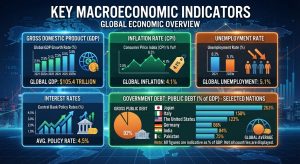
Unveiling Economic Performance: Discovering Closely Guarded Insights
1.Exploring the Covert Force of Informal and Shadow Economies
2.Understanding the Impactful Role of Institutional Trust and Rule of Law
3.Unraveling the Accelerating Effect of Micro-Liquidity and Local Cash Circulation
4.Unveiling the Silent Pressure of Demographic Changes and Age Dependency Ratios
Macroeconomic indicators
Supporting decision-makers such as policymakers, investors, international organizations, and businesses in keeping track of economic patterns and guiding their choices is crucial. Various institutions like the International Monetary Fund, the World Bank, and the Organisation for Economic Co-operation and Development rely on these metrics to gauge the overall economic well-being globally.
Macroeconomic indicators serve as quantitative tools to assess an economy’s holistic performance. They play a vital role in determining whether an economy is thriving, decelerating, or encountering obstacles like inflation, unemployment, or diminishing investments.
On a global scale, these metrics enable economists to compare economic landscapes across nations and pinpoint universal trends.
Why Are Macroeconomic Indicators Important?
These markers serve the following purposes:
– Evaluating economic advancement and progress.
– Anticipating economic hurdles in advance.
– Directing governmental financial and monetary strategies.
– Assisting in investment and business choices.
– Contrasting economic achievements across nations.
– Predicting forthcoming economic patterns.
In instances such as a rapid increase in inflation coupled with a deceleration in economic growth, policymakers might find it necessary to amend interest rates or government expenditure.
Gross Domestic Product (GDP)
The Gross Domestic Product (GDP) represents the overall worth of goods and services generated within a nation over a given timeframe, typically a year. It holds significant importance as a primary macroeconomic gauge, showcasing the scale and expansion of an economy.
Global GDP Growth
The Gross Domestic Product (GDP) is a metric that quantifies the overall value of all goods and services generated within a specific economy.
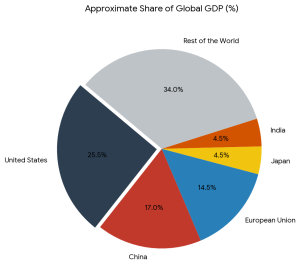
In the past few decades, the global economy has experienced substantial growth. The worldwide GDP has surged from about $34 trillion in the year 2000 to surpassing $100 trillion in more recent times. Key players in driving this global production include
| Economy | Approximate Share of Global GDP |
|---|---|
| United States | 25–26% |
| China | 16–18% |
| European Union | 14–15% |
| Japan | 4–5% |
| India | 4–5% |
Generally, countries that witness continuous growth in their GDP tend to witness an increase in incomes, enhanced infrastructure, and more investment prospects.
Almost every country is impacted by inflation. After the COVID-19 outbreak and disruptions in the supply chain, numerous nations faced abnormally high inflation rates.
Elevated inflation diminishes the ability to buy goods and services, escalating the overall living expenses. To mitigate inflationary forces, central banks globally frequently opt to elevate interest rates. Would you like to delve deeper into the subject?
GDP, GDP per Capita, and PPP: 3 Brilliant Comparison Economic Masteries
Inflation Rate
High inflation erodes the purchasing power of individuals, while a moderate inflation rate is generally viewed as beneficial, signaling a healthy economy through a gradual increase in the overall price level of goods and services.
Illustration
Suppose a sack of flour is priced at Rs. 2,000 currently and is anticipated to be Rs. 2,200 in the following year:
Calculation of Inflation Rate: 10%
Illustrative Instances of Recent Inflation
5 Critical Causes and Effects of Inflation: Impact on Global Economies
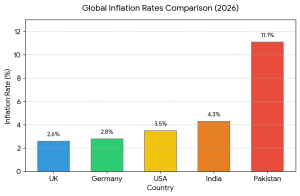
Global Inflation Trends Table (2026)
| Country | Inflation Trend | Current Inflation Rate | Economic Context & Outlook |
|---|---|---|---|
| United States | Moderate | 3.5% | Controlled inflation near target levels is maintained through the implementation of a stringent monetary policy. |
| United Kingdom | Moderate | 2.6% | Prices were stabilized due to the alleviation of supply chain issues and the impact of high interest rates. |
| Germany | Moderate | 2.8% | Energy expenses may vary marginally but are generally managed well. |
| India | Relatively Stable | 4.3% | Despite occasional disruptions in food supply, price stability has been maintained. |
| Pakistan | High | 11.1% | Double-digit rates are being fueled by high energy tariffs and structural deficits. |
Global Unemployment Trends
Why It Matters
The Impact of Interest Rates Transcends National Boundaries
Interest Rates on Global Economic Growth (Best Guide for 2026)
Balance of Trade
Trade
Foreign Direct Investment (FDI)
Exploring Government Debt Worldwide
In various nations, government debt is a common financial strategy, especially employed during economic recessions, financial turmoil, or significant infrastructural endeavors. The extent of public debt varies across countries concerning the size of their economies.
Japan
one of the countries with the highest debt-to-GDP ratios globally.
The United States
also maintains a substantial government debt level.
Italy
is grappling with a substantial public debt burden when compared to several European counterparts.
Germany
sustains a moderate level of debt and is generally perceived as financially robust.
India
manages a reasonable amount of debt while actively investing in economic expansion and public infrastructure.
Pakistan
also struggles with a relatively heavy debt load, attributed to budget shortfalls, large-scale development initiatives, energy-related commitments, and external borrowings, which have collectively escalated government debt levels in recent years.
Examining the Liabilities of Nations and the Trends in National Debt-to-GDP Ratio:
Across the globe, governments bear varying levels of debt, presenting a diverse economic landscape. Some countries grapple with debt surpassing the size of their economy, whereas others uphold a more modest debt burden.
Japan: Tallying approximately 220% of GDP, Japan ranks among the world’s most indebted nations.
United States: Reflecting years of extensive public spending and economic stimulus initiatives, the US exhibits a government debt of around 125% of GDP.
Italy: Among the highest in Europe, Italy’s debt hovers at roughly 138% of GDP.
India: With public debt nearing 84% of GDP, India persistently channels funds into developmental and infrastructural projects.
Pakistan: Wrestling with a debt equivalent to about 75% of GDP, Pakistan faces ongoing fiscal management and economic stability hurdles.
Germany: Boasting a debt ratio of roughly 60% of GDP, Germany maintains a relatively moderate public debt level.

Critical Debt Levels:
Japan and the United States shoulder substantial debt loads at 220% and 125% of their respective GDPs, mostly sustained by public investments in infrastructure.
Emerging Economies:
India and Pakistan handle more manageable debt ratios of 84% and 75% as they prioritize funding local development initiatives and tackling budget shortfalls.
Budgetary Resilience:
Among the countries mentioned, Germany stands out with a prudent debt level of 60%, meeting the criteria for long-standing fiscal stability.
Debt-to-GDP Ratio:
Although borrowing can bolster economic progress, an excessive debt load may pose fiscal obstacles in the future.
Understanding Exchange Rates and Global Economic Influences
The concept of exchange rates revolves around indicating the value of a nation’s currency in relation to another. For instance, if 1 US Dollar equals 280 Pakistani Rupees, any fluctuation in this rate has significant repercussions on various aspects such as import prices, export competitiveness, and foreign investment. When a currency weakens, the cost of imports tends to rise.
Exchange Rates:
Recent Global Economic Shocks:
Future Trends in Global Macroeconomic Indicators:
Exploring the Synergy of Macroeconomic Indicators:
In the realm of economics, the harmonious interplay of various indicators is crucial for gaining a comprehensive understanding of economic dynamics.
One may witness a robust GDP growth trend, accompanied by a surge in inflation rates, while the specter of high unemployment still looms large.
To illustrate this concept further, consider the case of Pakistan:
– GDP Growth: 4%
– Inflation: 12%
– Unemployment: 7%
– Trade Deficit: $18 Billion
These numbers hint at a burgeoning economic landscape, yet underscore pressing issues like inflation management and trade imbalances that demand immediate policy interventions.
Navigating the Nuances of Macroeconomic Signals:

Despite their utility, macroeconomic indicators come with inherent challenges that must not be overlooked:
– Timely data collection remains a persistent issue.
– The shadow economy often evades formal documentation.
– Short-term market fluctuations can skew interpretations.
– Diverse indicators may occasionally present conflicting narratives.
Hence, policymakers are tasked with the responsibility of deciphering these signals judiciously to formulate effective strategies.
A Global Examination of Debt Dynamics
Debt serves as a vital instrument for countries to propel infrastructure projects and mitigate economic downturns. However, the debt landscape varies significantly across nations. Assessing a country’s debt burden in relation to its GDP provides a cogent insight into its fiscal well-being. Delve into the comparative analysis below to grasp how major economies worldwide manage their borrowing in the context of their economic output.
Examples
| Country | Debt-to-GDP Ratio |
|---|---|
| Japan | Very High |
| United States | High |
| Italy | High |
| Germany | Moderate |
| India | Moderate |
Conclusion
Understanding global macroeconomic indicators is crucial for analyzing economic performance at both national and international levels. Key indicators like GDP growth, inflation, unemployment rates, trade balances, interest rates, government debt, exchange rates, and foreign investments play a vital role in assessing economic conditions and forecasting future trends. As the world becomes more interconnected, the monitoring of these indicators grows in significance. Nations that uphold stable macroeconomic fundamentals typically stand in a better position to achieve sustainable growth, attract investments, generate employment opportunities, and enhance living standards.
Global macroeconomic indicators offer a holistic view of the world’s economic well-being. GDP, inflation, unemployment, trade activities, investments, government debts, and exchange rates are fundamental metrics utilized by economists and policymakers. Together, these indicators facilitate the understanding of how economies expand, tackle challenges, and engage with the global economic landscape.
References & Best Alternatives:
International Monetary Fund IMF Data Mapper
investopedia economic indicators Guide

As an economics writer at Tech and Tips Economy, Siraj Ullah focuses on demystifying economic policies and financial data. His primary goal is to ensure that general economic topics are clear and easy to understand for the everyday reader. By adjusting the depth and length of his articles based on topic complexity, Siraj works tirelessly to bring approachable economic insights directly to his audience.
BEST COLLECTION TOPIC